Three days that cover the Upper Town on foot from the market to the noon cannon, the Lower Town's parks and the museums that have reopened since the 2020 earthquake, and a long day at Plitvice Lakes by bus.
May, June and September are warm and dry enough to walk all day. July and August are hot and the city empties for the coast. Advent in Zagreb runs from November 28, 2026 to January 7, 2027 and fills the parks with markets; book a room early for those weeks. Plitvice is cheapest and quietest from November to March, but the upper boardwalks can close for ice.
Where to base yourself
Sleep in the Lower Town between Ban Jelačić Square and the station: every tram passes, the parks are outside the door and the Upper Town is a ten-minute walk uphill. The Upper Town itself is quiet and pretty but has few rooms. Avoid anything west of Črnomerec or across the Sava unless you have a car.
Getting around
Walk. The center is small and the Upper Town is pedestrian. Trams cover the rest: a 30-minute ticket is €0.53, 60 minutes €0.93, 90 minutes €1.33 and a day ticket €3.98, bought in the Moj ZET app or at Tisak kiosks (the driver charges more). There is no tap-on-board yet; the city opened the tender for bank-card validators in September 2026, so check before you assume you can tap. The funicular to the Upper Town is €0.66 and runs every ten minutes from 6:30 a.m. to 9:50 p.m.; it reopened in May 2026 after a year of repairs.
The red umbrellas above the main square: fruit and cheese on the raised terrace, meat and dairy in the hall underneath, fish at the back. Open from 7 a.m. to 3 p.m., Sundays to 1; go before 10 and buy cornbread from the dairy stalls for later.
The 2020 earthquake broke a spire and the towers are being rebuilt, so expect scaffolding. The nave reopened to visitors on April 17, 2026, daily 8 a.m. to 7 p.m. and free; Sunday Mass at 10 a.m. pauses visits.
The old stream bed turned cafe street. Walk it now while it is quiet, since it is the evening on Day 3; the lane up on the left, Krvavi most, leads to the Stone Gate.
The last medieval gate, now a shrine to a painting of the Virgin that survived a fire in 1731. People pray here on their way to work, so walk through quietly and do not photograph them.
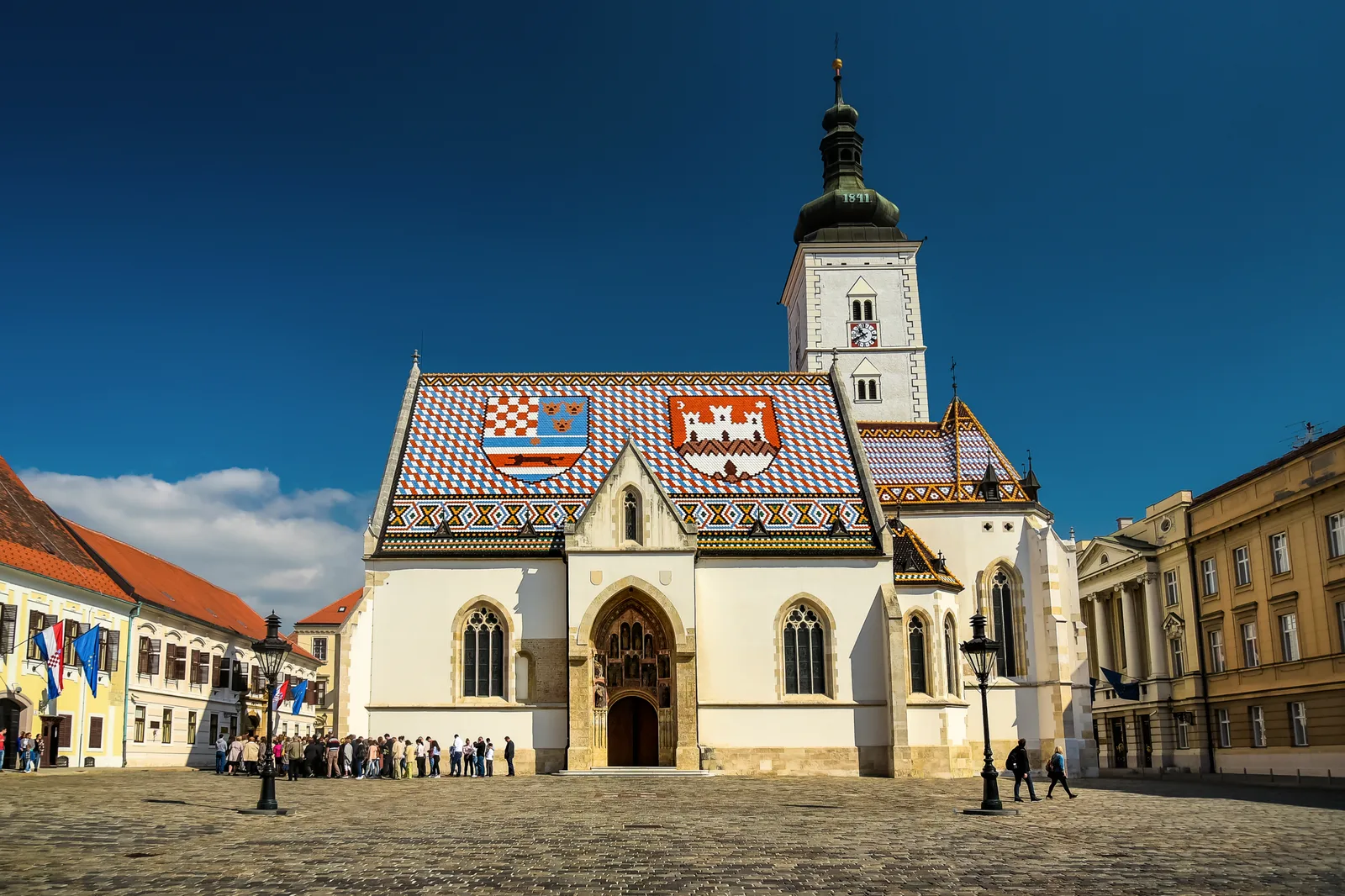
Look at the tiled roof with the two coats of arms. The church opens only for Mass, and police control the edges of the square since the 2020 attack on the government building; you can walk it, but not sit on it.
Objects left over from ended relationships, each with its story; 45 minutes is right. €9, open daily 9 a.m. to 9 p.m. (10 p.m. in summer), two minutes from St Mark's.
Be on the Strossmayer promenade below the tower at 11:55 a.m.; the Grič cannon has fired at noon every day since 1877 and it is loud. Then climb the tower for the roofs (€3, closed Monday), or on a Monday keep just the cannon.
Zagreb cooking in a wood-panelled room three minutes from the funicular. Order the zagrebački odrezak (a veal cutlet stuffed with ham and cheese) or sarma, with soup first; open 11 a.m. to 11 p.m. daily, no reservation needed at lunch.
The long shopping street and the main square with the horseman. Coffee at one of the square's cafes, then the shops along Ilica as far as Britanski trg, where a Sunday antiques market runs.
Ride the funicular back up for the sunset over the Lower Town roofs along the chestnut-lined promenade on the old southern wall. In summer there are stalls and music, and in Advent it is a market.
A courtyard restaurant in the Lower Town that locals use for family dinners: lamb from Pag is the dish, the pašticada the other. Open noon to midnight; reserve, especially Friday and Saturday.
Start at the station and walk north through the parks: King Tomislav Square, Strossmayer Square and Zrinjevac with its music pavilion and the weather station from 1884. Then west to Marulić Square; the horseshoe is the plan of the 1880s city and still reads on the ground.
Both face Roosevelt Square and both were damaged in 2020. As of October 2026 the Mimara is still closed and the Museum of Arts and Crafts has been shut since January 2022, so check both; the National Museum of Modern Art on Hebrangova is the open substitute.
The university's garden at the bottom of the horseshoe, free, open from April to early November and closed in winter. The ponds and glasshouses are the bits to find; twenty minutes is enough.
Štrukli are the Zagreb dish: pastry filled with fresh cheese, boiled or baked, savory or sweet, and this place serves only štrukli in a courtyard below Dolac. Order the baked one with sour cream and a sweet one with walnuts; open daily from 11 a.m., with a line at one, so arrive at noon.
Peasant painters on glass, Generalić and the Hlebine school, in a few rooms opposite the Museum of Broken Relationships. Weekdays 9 a.m. to 5 p.m., Saturday 10 a.m. to 2 p.m., closed Sunday; the ticket is a few euros.
Take bus 106 from the stop by the Cathedral on Kaptol, ten minutes. Bollé's arcades and domes are the thing to see, though parts are still under restoration behind screens; open 6 a.m. to 8 p.m. April to October, 7:30 a.m. to 6 p.m. in winter, so keep your voice down.
Zagreb's afternoon is a long coffee on a terrace, and Saturday morning's version, the špica, is a dress-up ritual. Take bus 106 back to Kaptol, then walk to Petar Preradović Square (everyone calls it Cvjetni); one coffee, around €2, buys the table for as long as you like.
A small bistro and wine bar in the lane under the Upper Town wall, by Dolac, with a short menu that changes with the market and Croatian wines by the glass. Book a table; it is small and in the Michelin guide.
Buses leave from the main bus station (tram 6 from the center) and take 2 to 2.5 hours, about €15 one way; the first goes around 6:45 a.m. Book both legs online in summer and get off at Entrance 1 (Ulaz 1); Entrance 2 is the upper lakes.
Buy the ticket online for a specific entrance and hour; you cannot enter early and may be at most an hour late. Route B from Entrance 1 is 4 kilometers, 3 to 4 hours with the boat, and Route C adds the upper lakes; the park opens at 7 a.m. in the warm months.
The park's own restaurant across the road from Entrance 1, a wooden hall with an open hearth. Order the Lika lamb or lička juha (a thick soup) and the cheese with cream, or carry a picnic from Dolac.
Return buses stop at both entrances roughly 4 to 6:30 p.m.; the schedule thins in winter, so check the last one before you set out. Buses run late in summer traffic, so do not plan anything in Zagreb before 7 p.m.
The cafe street from Day 1 as it is meant to be seen, with every terrace full: a craft beer and ćevapi or a burek at whichever table has room, then a last drink on the Strossmayer promenade if the night is warm.
€20
Loading the map…
Pins are approximate. Tap one for the stop; the directions links open Google Maps.
The practical bits
From the airport
From Franjo Tuđman Airport (ZAG), the Pleso shuttle runs every 30 minutes to the main bus station in about 35 to 40 minutes for €9, then tram 6 to Ban Jelačić Square. City bus 290 is cheaper but slower and stops at Kvaternik Square. A taxi to the center is around €25 to €35. Trains from Ljubljana take about 2 hours 20, buses from Budapest and Vienna about 4 to 5 hours.
What a day costs
About €60 to €90 a day per person for meals, tickets and trams; Zagreb is cheaper than Vienna or Ljubljana. The Plitvice day costs €55 to €75 for the bus and ticket in spring and fall, €70 to €90 in summer.
Where to stay
Upper Town (Gornji grad)
Gradec and Kaptol on their two hills: the Cathedral, St Mark's, the small museums and the promenade. Quiet after dark, few rooms, all of it on foot.
Lower Town (Donji grad)
The 19th-century grid between the main square and the station, with the horseshoe of parks and most hotels. Every tram passes through, so it suits first-time visitors.
Tkalčićeva and Dolac
The café street and the market in the dip between the two hills. Loud until midnight; good for eating, less good for sleeping unless you like the noise.
Got a day to spare?
Plitvice Lakes
Sixteen terraced lakes and the waterfalls between them, 2 to 2.5 hours by bus. Day 3 covers it; in summer book the timed ticket and the first bus.
Samobor
A small baroque town under the hills, 40 minutes by bus from Črnomerec. Go for the kremšnita custard slice on the square and the walk up to the castle ruin; half a day is enough.
Medvednica and Sljeme
The city's mountain. The cable car (€10 round trip) goes to the top in about 20 minutes; the walk down through the forest to Medvedgrad castle takes two hours. Tram 14 to Mihaljevac, then a short bus to the lower station.
Worth knowing
Croatia uses the euro (since January 2023) and is in Schengen; cards work everywhere in the city, but keep coins for the market and the tram kiosk.
Buy tickets in the Moj ZET app and activate one as you step on; inspectors are common and the fine is many times the fare.
The 2020 earthquake still shapes the city: the Cathedral's towers are shortened and scaffolded, the Mimara and the Museum of Arts and Crafts are closed, and some Upper Town facades are propped. Check a museum's own site the week you travel.
Lotrščak Tower and most museums close on Monday. Make Monday your Plitvice day if the dates allow.
At Plitvice buy the timed ticket online before the bus leaves Zagreb and screenshot it; adults pay €November 10 to March, €April 23, May and October, and €June 40 to September (€25 after 4 p.m.), boat and train included. The signal at the entrances is poor and the gate line is long in summer.
Things you can ask once it’s in the app
Plans change. Ask Chat and it proposes a reshuffled day you can apply, or just answers the question.
Is the Mimara open yet, and what do I swap in if not?Which Plitvice route should we do with a seven-year-old?Make me a rain plan for day 1What time is the last bus back from Plitvice in October?How much is the tram from the bus station to Ban Jelačić Square and where do I buy it?
Questions
Is three days enough for Zagreb?
Two days for the city is right; the third adds Plitvice. A fourth day would go to Samobor and a walk on Medvednica, or to the wine villages of Plešivica.
Is Plitvice doable without a car?
Yes. Buses from the main station take 2 to 2.5 hours, around €15 each way, and stop at both entrances. Book the bus and the timed park ticket ahead in summer, and leave on the first departure so you have four hours inside.
Which day works in the rain?
Day 2: the Museum of Broken Relationships, the Naive Art museum and the cafes are all indoors, and Mirogoj's arcades keep you dry. Waystop's rain plan can add a wet-weather version of the Plitvice day, so you decide on the morning.
Can I visit the Cathedral?
Yes. It reopened to visitors on April 17, 2026, daily 8 a.m. to 7 p.m., free. The towers are still being rebuilt after the earthquake, so expect scaffolding outside and a shorter skyline than the old photos.
Add your dates, your hotel and who’s coming, then ask Chat to change anything: it proposes the edit and you tap Apply. Want a long lunch instead of a museum? Just ask. Every place is checked against Google Maps before it lands on your day, and Chat can tell you when to leave for the next stop. Going on to another city? Build a multi-city trip.