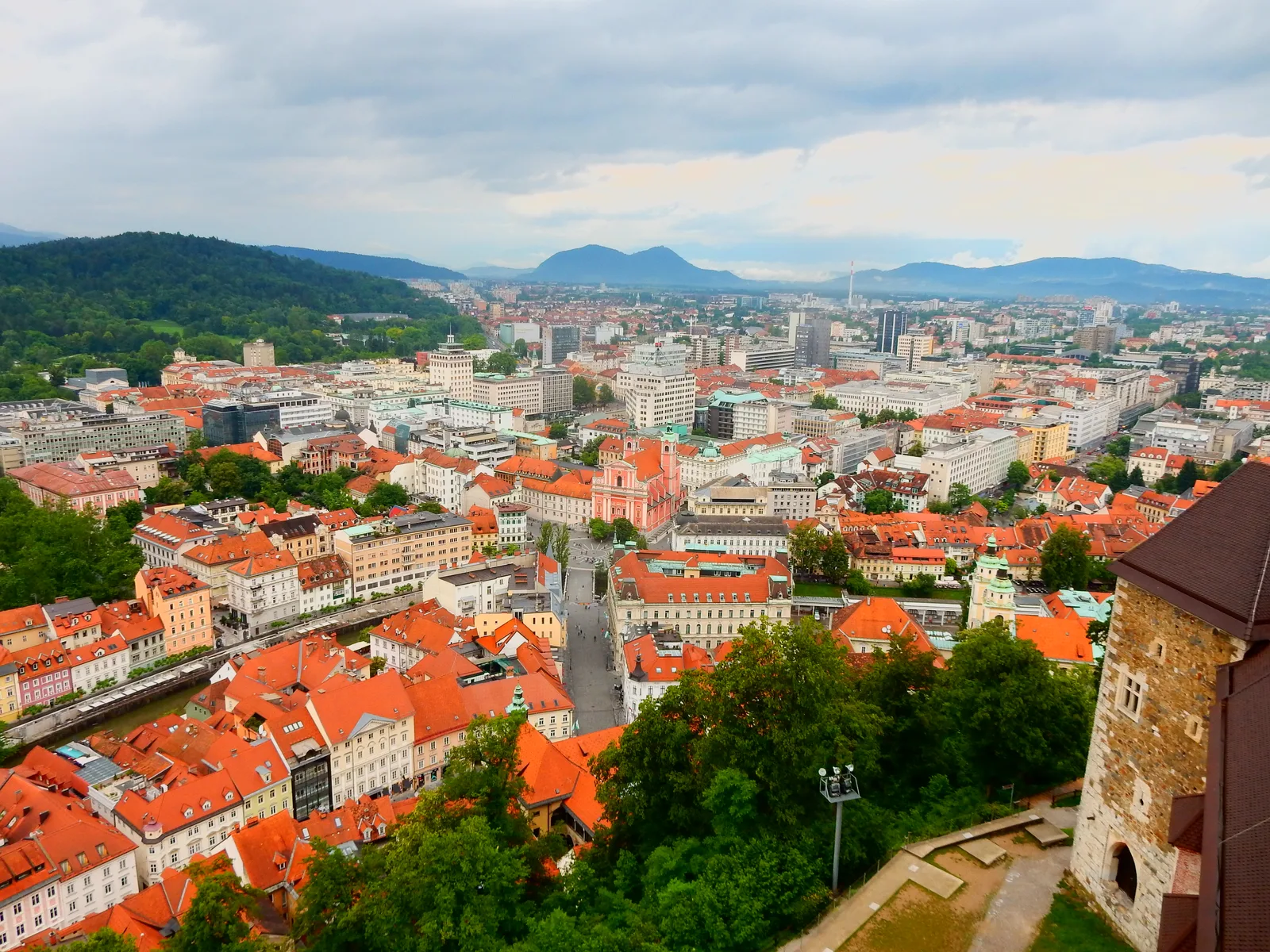
Three days built around a small, walkable capital: the old town, the market and the castle on foot, a full day at Lake Bled with the gorge, then Plečnik's buildings and the parks, with Postojna Cave as the swap if you would rather go underground.
May, June and September bring warm days, long evenings and Bled without the August crush. July and August are hot (often above 86°F, 30°C) and the lake is busy. October brings fall color and the Vintgar Gorge season ends around then; from November to March the gorge is shut, the Open Kitchen market is off and Bled is quiet, sometimes snowy.
Where to base yourself
Sleep in the old town or just across the river around Prešeren Square for everything on foot. Trnovo and Krakovo, ten minutes south along the river, are village-quiet and next to the Plečnik House. The streets around the railway and bus station are practical for the Bled and Postojna days but charmless at night.
Getting around
The center is car-free and you will walk almost everything. City buses take an Urbana card (€2 for the card, then €1.50 a ride with free transfers for 90 minutes) or a contactless Visa or Mastercard tapped on board at the same fare; the single fare went up to €1.50 on October 1, 2025. The funicular is the only ride most people take in town. Intercity buses to Bled leave from the bus station in front of the railway station; trains to Postojna leave from the station itself.
Start at the open-air stalls on Vodnikov trg, then walk Plečnik's curved riverside colonnade: fish downstairs, bread and cheese shops along the top. Closed Sundays and best on Saturday mornings.
Plečnik widened a single bridge into three in the 1930s. Stand on the square side for the pink Franciscan church, then cross to the Robba fountain and the town hall on Mestni trg.
Walk back along the market side of the river to the four copper dragons, the city's symbol since 1901. Ten minutes is plenty; the funicular station is a short walk behind the market.
The ticket covers the funicular round trip, the viewing tower, the puppet museum and the history exhibition. Tickets stop selling an hour before closing.
On dry Fridays from late March to late October the Open Kitchen market fills the square by the cathedral from 10 a.m., unless rain is forecast. Any other day, Klobasarna at Ciril-Metodov trg 15 does Carniolan sausage with mustard and horseradish for around €6.
The three squares are one long curving street under the castle: baroque fronts, small shops, the cathedral's bronze doors. Walk it slowly to the Hercules fountain at the top and back along the riverside.
Walk the riverside from the Cobblers' Bridge to the Butchers' Bridge as the lights come on; the cafés on Cankarjevo nabrežje and Petkovškovo nabrežje are where the city sits down. A 45-minute boat trip leaves from near the Butchers' Bridge if you would rather float.
A small restaurant on Stari trg with Slovenian and Mediterranean plates; the štruklji (rolled dumplings) and a glass of Štajerska white. Book a day ahead for a terrace table in summer.
A former army barracks behind the railway station that became an autonomous arts quarter in 1993: murals, sculptures made of scrap, half a dozen small bars and clubs. Liveliest Thursday to Saturday after 10 p.m.; wander the yard even on a quiet night.
Arriva and others run more than 20 buses a day from the Ljubljana bus station (in front of the railway station) to Bled, 1 hour to 1 hour 20. Get off at the final Bled stop, not Bled Union, for the lake.
Timed tickets at tickets.vintgar.si; the shuttle runs from the Bled bus station and the gorge opens at 9 a.m. from late September (8 a.m. in summer). It closes at 3 p.m. from September 21 and earlier than the lake sights, so it comes first.
The full loop is about 6 km and two hours; the south shore from the town to Mlino is 30 to 40 minutes, with the island framed by the castle most of the way. Carry on round after the boat if you have the legs.
The flat-bottomed wooden boats leave from Mlino and from the town jetties when they fill, about 20 minutes each way. Climb the 99 steps to the church; the bell tower has a small extra fee.
The lakeside café of the Hotel Park, where the Bled cream cake (kremšnita) was first made in 1953. Have one with a coffee, and find something savory at a lakeside gostilna if you need a proper lunch.
A steep 15-minute path up from the lake, open 8 a.m. to 8 p.m. April to October and to 6 p.m. in winter. The terrace is the postcard view of the island; the museum and printing press inside are quick.
Buses run into the evening; check the last departure when you arrive in the morning and allow for the shuttle back from the gorge. An open round-trip ticket saves a second line.
Plečnik's bridge with birch trees growing out of it, and the vegetable plots of Krakovo that still supply the market. Ten minutes south of the old town along the river; the Plečnik House is just over the bridge.
The architect's home at Karunova 4, kept as he left it in 1957. Visits are by guided tour on the hour, Tuesday to Sunday 10 a.m. to 6 p.m., closed Monday.
A medieval monastery that Plečnik turned into an open-air theater in the 1950s, with the Illyrian monument he designed on the square outside. The courtyard is usually open to walk through, and concerts fill it on summer evenings.
Plečnik's brick and stone library of 1941: climb the dark marble stair into the light. The lobby is open to visitors, and tourists are let into the Great Reading Room on Saturday afternoons, roughly 2:30 to 6 p.m., for about €5.
A social-enterprise restaurant at Stari trg 21 that trains and employs people with disabilities. Goulash soup, jota (sauerkraut and bean stew) or a Slovenian plate come to well under €15, five minutes from the library.
Walk through Congress Square and under Slovenska cesta into the park; Plečnik's wide promenade with its lamps leads to Tivoli Castle, where there is an outdoor photo exhibition most of the year.
Moderna galerija at Cankarjeva 15, on the park's edge: Slovenian art from the 1900s to the 1990s, strong on the inter-war decades and the partisan years. Open Tuesday to Sunday 10 a.m. to 6 p.m., closed Monday.
A last dinner on the river under the willows: Slovenska hiša for a board of Carniolan cured meats and Tolminc cheese, or whichever terrace has a free table by the water. Finish with a walk over the Cobblers' Bridge, lit after dark.
Loading the map…
Pins are approximate. Tap one for the stop; the directions links open Google Maps.
The practical bits
From the airport
From Ljubljana Jože Pučnik Airport (LJU), bus 28 runs to the central bus station at least hourly from about 5 a.m. to 9 p.m., 45 to 55 minutes, for around €3 to €4 paid on board by card or cash. The Nomago shuttle is €12 and more frequent; a taxi costs several times that. From Trieste, Zagreb or Venice, intercity buses and FlixBus are 2 to 3 hours.
What a day costs
About €60 to €90 a day per person for meals, the castle, buses and a drink or two. The Bled day runs higher: bus, pletna, castle and gorge come to about €70 before lunch. The Ljubljana castle ticket is €19 (€17.10 online) and the funicular alone €6; the Plečnik House is €12 with the tour or €8 for the exhibition only (book the 10 a.m. slot online in summer); Vintgar is €15 for adults and €5 for children (the shuttle may cost extra), booked at tickets.vintgar.si.
Where to stay
Old town and the riverside
Mestni trg to Gornji trg under the castle, plus café terraces along both banks. The terraces stay busy until around midnight, so ask for a room off the river.
Trnovo and Krakovo
Allotments, low houses and the Plečnik House, ten minutes south along the river. The old town is about a ten-minute walk north, and evenings are quiet.
Center and Tivoli
Slovenska cesta, Congress Square and the park beyond, with the museums at its edge. The bus and railway stations are ten minutes' walk north, handy for the Bled and Postojna mornings.
Got a day to spare?
Postojna Cave and Predjama Castle
Trains from Ljubljana reach Postojna in about an hour for around €6, then a 25-minute walk or a taxi to the cave; tours leave on the hour (9 a.m. to 4 p.m. in winter, to 5 or 6 p.m. in summer) and last an hour and a half with the cave train. €34.90 for the cave, €58.90 combined with Predjama, the castle built into a cliff 9 km away; a taxi or the summer shuttle links them. Bring a jacket: 50°F (10°C) underground.
Škocjan Caves
The UNESCO-listed caves with the vast underground canyon. Train to Divača, about an hour and a half, then a signed 40-minute walk or the seasonal shuttle; tours are guided and timed, so check the day's departures before you leave.
Piran
A Venetian harbour town on Slovenia's 46 km of coast. Buses take around 2 hours 30; go for the square, the walls and a plate of fried squid, and come back on the evening bus.
Worth knowing
Buy an Urbana card (€2) at any urbanomat machine or simply tap a contactless Visa or Mastercard on the bus; both charge €1.50 with 90 minutes of transfers, up from €1.30 since October 1, 2025.
Monday closes the Plečnik House and the Museum of Modern Art, and the Central Market shuts on Sunday. Make day 2 (Bled) your Monday and keep Saturday for the library's reading room.
The castle (€19, or €17.10 online), pletna, Bled Castle (€19) and the gorge add up to about €70 before food. The Ljubljana Card only pays off if you tour several city museums; it does nothing at Bled.
Carry cash for the pletna boatmen (around €20 a person round trip, paid on the way back) and the small market stalls; everywhere else takes cards.
The Vintgar Gorge closes at 3 p.m. from September 21 (4 to 6 p.m. earlier in the season), so it is the first stop of the Bled day and the lake comes after. Waystop's hours check flags a gorge slot placed after closing.
Things you can ask once it’s in the app
Plans change. Ask Chat and it proposes a reshuffled day you can apply, or just answers the question.
Swap day 3 for Postojna Cave and Predjama and tell me the train timesIf it rains on our Friday, what replaces the Open Kitchen lunch?We land at 3 p.m. and want to be in the old town by dinner; what is the easiest way in?Rebuild the Bled day so Vintgar Gorge comes firstWhich days are the Plečnik House and the Moderna galerija closed?
Questions
How should I split three days in Ljubljana?
The city itself takes a day and a half on foot, with the rest going to Plečnik and the parks. Days 2 and 3 can reach further: Bled, Postojna and the Škocjan Caves are each within an hour or two.
Is the Ljubljana Card worth buying?
The 24-hour card is €41, 48 hours €49 and 72 hours €54, and it covers the castle with the funicular, city buses, the river boat and most museums. It makes sense only if you pack day 1 and day 3 with museums; it does not cover Bled or Postojna.
Which day works in the rain?
Day 3 with the Postojna swap: the cave is 50°F (10°C) and dry in any weather, and the train runs regardless. In town, the castle, the Plečnik House and the Moderna galerija are all indoors. Ask Waystop for a rain plan and Chat builds a second version of day 2 that you switch to from the day's menu.
How do I get to Bled without a car?
The bus from Ljubljana bus station is the direct way, about an hour and a quarter, with departures through the day. A one-way ticket is around €6 on a weekday and less at weekends, bought at the counter or online. The train to Lesce-Bled is faster but the station is 4 km from the lake, so you add a short bus or taxi.
Add your dates, your hotel and who’s coming, then ask Chat to change anything: it proposes the edit and you tap Apply. Want a long lunch instead of a museum? Just ask. Every place is checked against Google Maps before it lands on your day, and Chat can tell you when to leave for the next stop. Going on to another city? Build a multi-city trip.