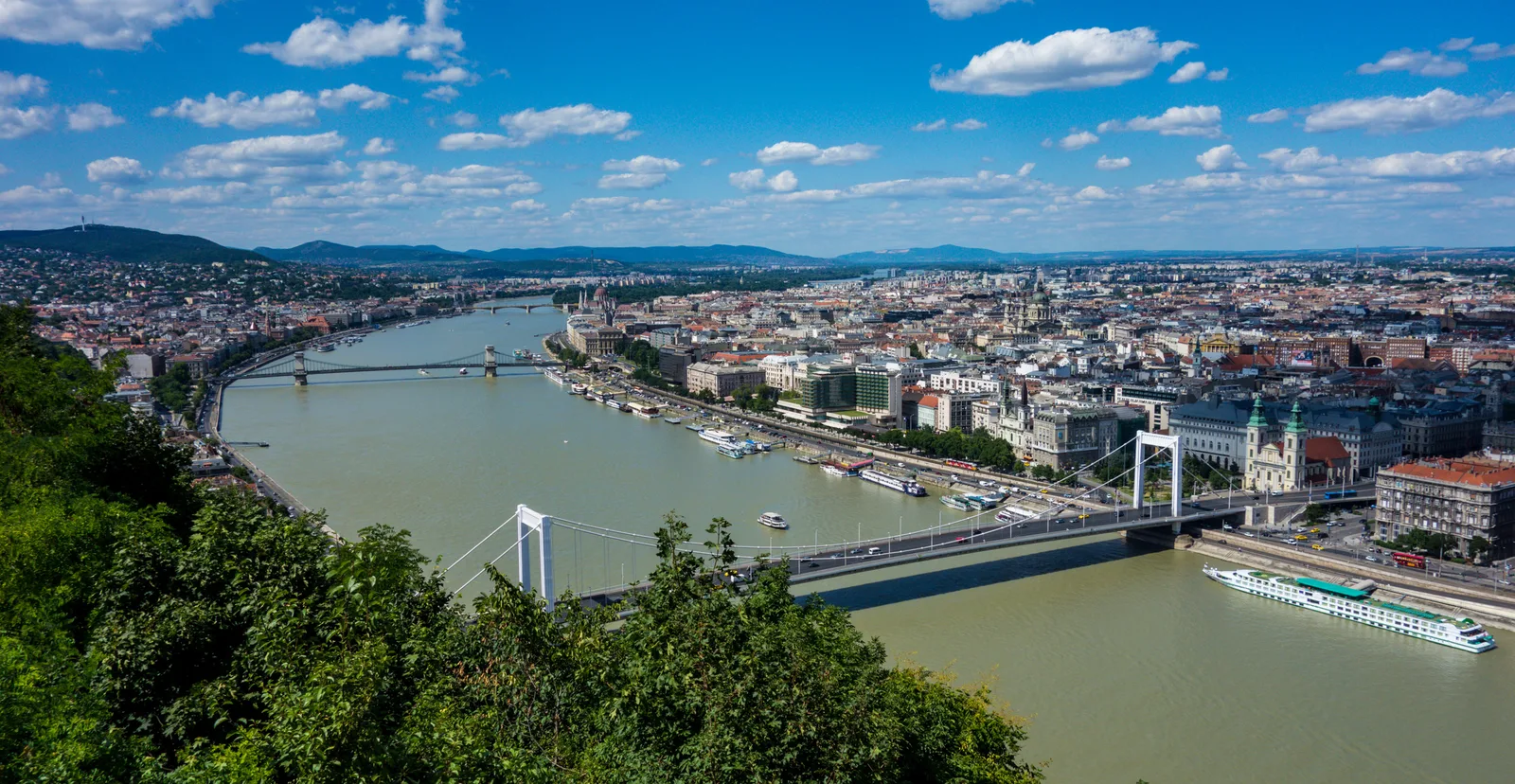
Three days split by the river: Buda's castle hill and a Turkish bath, Pest's Parliament, market and Jewish Quarter after dark, then the Széchenyi pools and the Danube at dusk from the 2 tram. One ride a day, the rest on foot.
April to June and September to October are the easy months: warm days, cool evenings, the bath terraces in use. July and August run hot, often past 86°F (30°C), and the Sziget festival fills the city for a week in August. Winter is cold and gray but the outdoor pools steam, the Christmas markets run from mid-November, and hotels are cheap.
Where to base yourself
District V (Belváros and Lipótváros) puts the Parliament, the basilica and the 2 tram on foot and is quiet after dark. District VII, the Jewish Quarter, is the food and bar district; sleep on a courtyard side or you will hear it until four. Víziváros and the Castle District on the Buda side are calm, pretty and one bridge from everything.
Getting around
The metro, trams and buses are one BKK network: a single ticket is 500 Ft (700 Ft on board), a 24-hour travelcard 2,750 Ft and a 72-hour travelcard 5,750 Ft, which is the one to buy for this trip. Paper tickets must be punched in the validator before you ride; the BudapestGO app sells tickets that activate on purchase. Tram 2 along the Pest embankment is the ride worth taking for its own sake, and the city is small enough that most of each day here is on foot.
The funicular from Clark Ádám tér starts at 8 a.m. and costs 4,500 Ft one way; it is closed on some Mondays and from October 5 to 16, 2026 for maintenance, so check the schedule. The steps beside it take ten minutes and are free.
The upper towers are free before 9 a.m. and 1,700 Ft after; the lower terraces are always free and have the same view of the Parliament across the river. Come now, before the tour groups.
Opens to visitors at 9 a.m. on weekdays and Saturday, around 3,400 Ft; Saturday closes early for weddings and Sunday it opens only after the midday mass. The painted interior is the point, not the outside.
Walk south through Szentháromság tér and Tárnok utca to the palace; the courtyards and the terrace above the river are free. Ruszwurm on Szentháromság utca for a krémes on the way.
Fortuna utca 3, open daily from 7:30 a.m. Hungarian home cooking: the beef pörkölt or the crispy duck leg. Book a table; the hill has few good lunches and everyone knows this one.
Down through the Tabán and up the paths behind the Gellért statue, about 40 minutes of walking. The Citadella reopened in March 2026; the park and terraces are free and open until midnight in summer, and bus 27 climbs most of it.
The pool under the dome by Erzsébet Bridge; the Gellért Baths are closed until 2028. A day ticket is 12,000 Ft Monday to Thursday and 15,000 Ft Friday to Sunday; no under-14s, swimsuits required, and the Turkish bath is single-sex on weekday mornings.
Across Szabadság Bridge from the baths, a ten-minute walk: a street of terraces. Pick one with Hungarians at the tables and order paprikás csirke with nokedli and a glass of Egri Bikavér.
Day 2
Pest: Parliament, the basilica, the market and the Jewish Quarter
Book the first slot online weeks ahead; tours sell out and none run on sitting days except Monday morning. The 45-minute tour is 7,000 Ft for EEA passport holders and 14,000 Ft for everyone else, and includes the crown jewels.
Fifteen minutes on foot through Szabadság tér. Every visitor needs a ticket: around 2,600 Ft for the church, 6,800 Ft with the panorama terrace; the nave opens at 9 a.m. except Sunday, when it opens at 1 p.m.
Tram 47 or 49 from Deák Ferenc tér to Fővám tér. Paprika and salami downstairs and lángos upstairs; open 6 a.m. to 6 p.m. weekdays, to 4 p.m. Saturday, and from 10 a.m. Sunday with half the stalls shut.
The M1 runs under the avenue; walk the first stretch instead, from Erzsébet tér to the Opera. English tours of the Opera usually run at 1:30 p.m., 3 p.m. and 4:30 p.m., around 10,500 Ft with a mini-concert; take the 3 p.m.
The largest synagogue in Europe, around 14,500 Ft with the museum. Closed Saturdays and Jewish holidays, shuts at 4 p.m. Friday and 6 p.m. in October, last entry an hour before; cover shoulders and knees.
Wesselényi utca 18, open daily from noon to 11 p.m.; book online. Hungarian stews done properly: the venison pörkölt with juniper, then the túrógombóc dumplings.
Kazinczy utca 14, the original ruin bar in a gutted tenement, open from the afternoon until about four. Go now, before the stag groups arrive at eleven; the farmers' market fills the courtyard Sunday mornings, 9 a.m. to 2 p.m.
Day 3
Széchenyi at opening, the park, and the Danube at dusk
Open from 7 a.m. weekdays, 8 a.m. weekends; the Good Morning Budapest ticket before 9 a.m. is 10,500 Ft Monday to Thursday, against 13,200 Ft for a standard day ticket (14,800 Ft Friday to Sunday). Buy online to skip the line, and bring a towel and flip-flops.
Vajdahunyad Castle across the boating lake is a 1896 exhibition folly, free to walk round. The House of Music, five minutes away, is free to enter; the sound exhibition is ticketed and the building is closed Mondays.
The Millennium Monument with the seven Magyar chieftains, flanked by the Museum of Fine Arts and the Kunsthalle. The museum's Old Masters are worth the 5,800 Ft if you have the appetite; it is open 10 a.m. to 6 p.m. and closed on Mondays.
Three stops on the M1 to Opera, then Nagymező utca 14. A proper café-bistro open from breakfast to late; the daily lunch menu is the value, otherwise the duck or the roast cauliflower soup.
Walk down through Szabadság tér, with its Soviet memorial and the US embassy facing each other, to Kossuth tér and the sixty iron shoes on the embankment below the Parliament. Fifteen quiet minutes there, then follow the river north to Jászai Mari tér.
Board the 2 at Jászai Mari tér and ride the Pest embankment south past the Parliament and the Chain Bridge; your travelcard covers it. Or take Legenda's one-hour evening cruise from the Vigadó pier for around €25 with a drink, timed for sunset at around 6 p.m. in early October.
Akácfa utca 47, a glass-roofed ruin garden with a kitchen that is better than the setting suggests: shakshuka, falafel, the lamb. Open daily from noon to 11 p.m., midnight on Friday and Saturday; book, it fills every night.
Loading the map…
Pins are approximate. Tap one for the stop; the directions links open Google Maps.
The practical bits
From the airport
From Ferenc Liszt airport, the 100E express bus runs to Deák Ferenc tér in the center in about 40 minutes for 2,500 Ft, round the clock and every ten minutes or so by day; travelcards are not valid on it without a supplement. The 200E bus to Ferihegy station and a train to Nyugati is the cheap route for about 1,000 Ft and 50 minutes. Taxis from the official rank outside arrivals run on the regulated meter and take about 35 minutes.
What a day costs
About 30,000 to 45,000 Ft a day per person (roughly €75 to €115) for a bath, one or two paid sights, a market lunch and a Jewish Quarter dinner, with transport on a 72-hour travelcard. The Parliament, basilica and synagogue together are about 28,000 Ft for a non-EEA adult, so a cheap day follows an expensive one.
Where to stay
Jewish Quarter (District VII)
Ruin bars, the synagogues, most of the restaurants in this plan. Loud until late on Kazinczy and Dob utca; quieter a street or two north.
Belváros and Lipótváros (District V)
The Parliament, the basilica, the river and the 2 tram, all on foot. Central, calm at night, pricier for a bed.
Víziváros and the Castle District
The Buda bank below the castle: quiet lanes, Batthyány tér for the HÉV to Szentendre, the Chain Bridge to Pest in ten minutes. Few restaurants after dark.
Got a day to spare?
Szentendre
A baroque artists' town on the Danube, 40 minutes on the H5 HÉV from Batthyány tér; your travelcard covers the city stretch and you add a short extension ticket for the rest. Half a day; the riverside and the Serbian church are the point.
Esztergom and the Danube Bend
Direct trains from Nyugati reach Esztergom and its basilica, the largest church in Hungary, in about an hour and a half. For Visegrád's castle, take the train to Nagymaros (under an hour) and the ferry across. Mahart boats run the bend from April to September and make a slow, lovely way back.
Lake Balaton
Direct trains from Déli reach Siófok on the south shore in about 90 minutes and Balatonfüred on the north in about two hours; Tihany's abbey and lavender are a 20-minute bus from Füred. A summer trip: catch a train before 8 a.m. for a full day.
Worth knowing
Buy the 72-hour travelcard (5,750 Ft) on arrival and punch every paper ticket before you ride; inspectors check at the metro gates and on the trams, and the fine is steep.
Prices are in forint and cards are taken almost everywhere, including market stalls and some bath cash desks that take nothing else. Carry a few thousand forint for toilets and kiosks, and when a terminal offers to charge you in euros or dollars, say no.
Look for a service charge (szervizdíj) of 10 to 15 percent at the bottom of the bill before you tip; most restaurants add it now and nothing more is expected. If it is not there, round up 10 percent.
Gellért Baths are closed until 2028. Széchenyi and Rudas sell tickets online; Széchenyi's morning ticket is cheaper before 9 a.m. and Rudas's Friday and Saturday night sessions are online only.
Parliament tours and the Opera sell out; the synagogue is shut on Saturday and the big museums on Monday. Waystop's hours check will flag a stop placed on its closed day, but put the Parliament booking in before you fly.
Things you can ask once it’s in the app
Plans change. Ask Chat and it proposes a reshuffled day you can apply, or just answers the question.
Parliament is sold out for our morning, what do we do instead?Is the Dohány synagogue open on the Saturday we're there?Swap Rudas for a bath that takes a 10-year-oldFind a vegetarian dinner near Szimpla KertBuild a Danube Bend day with the boat back
Questions
Is three days enough for Budapest?
Yes for the two hills, the Parliament, two baths and the Jewish Quarter at a real pace. Add a fourth day for Margaret Island and the Castle's museums, or Szentendre on the HÉV.
Is the Budapest Card worth it?
The 72-hour card is 29,990 Ft and includes transport, Lukács Baths and a cruise but only a discount on Széchenyi, Rudas and the basilica. For this itinerary the 5,750 Ft travelcard plus tickets as you go comes out cheaper.
Which day works in the rain?
Day 3: Széchenyi is better in the rain than the sun, the House of Music and the Museum of Fine Arts are indoors, and the 2 tram is dry. Ask Waystop's Chat for a rain plan and apply it to get a second version of the day to switch to.
Which baths need a booking?
None strictly, except Rudas's night bathing. Book Széchenyi online anyway to skip a long summer line, and note Gellért is closed for renovation until 2028.
Add your dates, your hotel and who’s coming, then ask Chat to change anything: it proposes the edit and you tap Apply. Want a long lunch instead of a museum? Just ask. Every place is checked against Google Maps before it lands on your day, and Chat can tell you when to leave for the next stop. Going on to another city? Build a multi-city trip.