Three days on foot: the Old Town and Wawel on the first, Kazimierz and the Podgórze ghetto on the second, then a day out to Auschwitz-Birkenau or the Wieliczka salt mine. The center is small enough that the Old Town, Wawel and Kazimierz sit within a 20-minute walk of each other.
May, June and September are the easy months: 64 to 77°F (18 to 25°C), long evenings, the Rynek terraces out. July and August push past 86°F (30°C) and the Old Town fills. December has the Christmas market on the Rynek, but the days end by 4 p.m., it drops below freezing, and coal smog can be bad on still days. March and April are cheap and gray.
Where to base yourself
Sleep inside the Planty ring or just outside it for everything on foot; Kazimierz for the bars and a quieter night; around Kraków Główny if you are arriving late or leaving early for Auschwitz. Avoid Floriańska itself unless you sleep through noise.
Getting around
Walk. The Old Town, Wawel and Kazimierz are all within 20 minutes of each other. For Podgórze, Nowa Huta or the station use the MPK trams: a new tariff from March 2, 2026 prices a single ride or 30-minute ticket at zł 6, 60 minutes at zł 8 and a 24-hour zone I ticket at zł 20. Buy in the jakdojade or mPay apps, or from the machines on board (cards work). Paper tickets go into the yellow validator the moment you board; app tickets are activated before you step on, and inspectors do not accept a ticket bought after the doors closed.
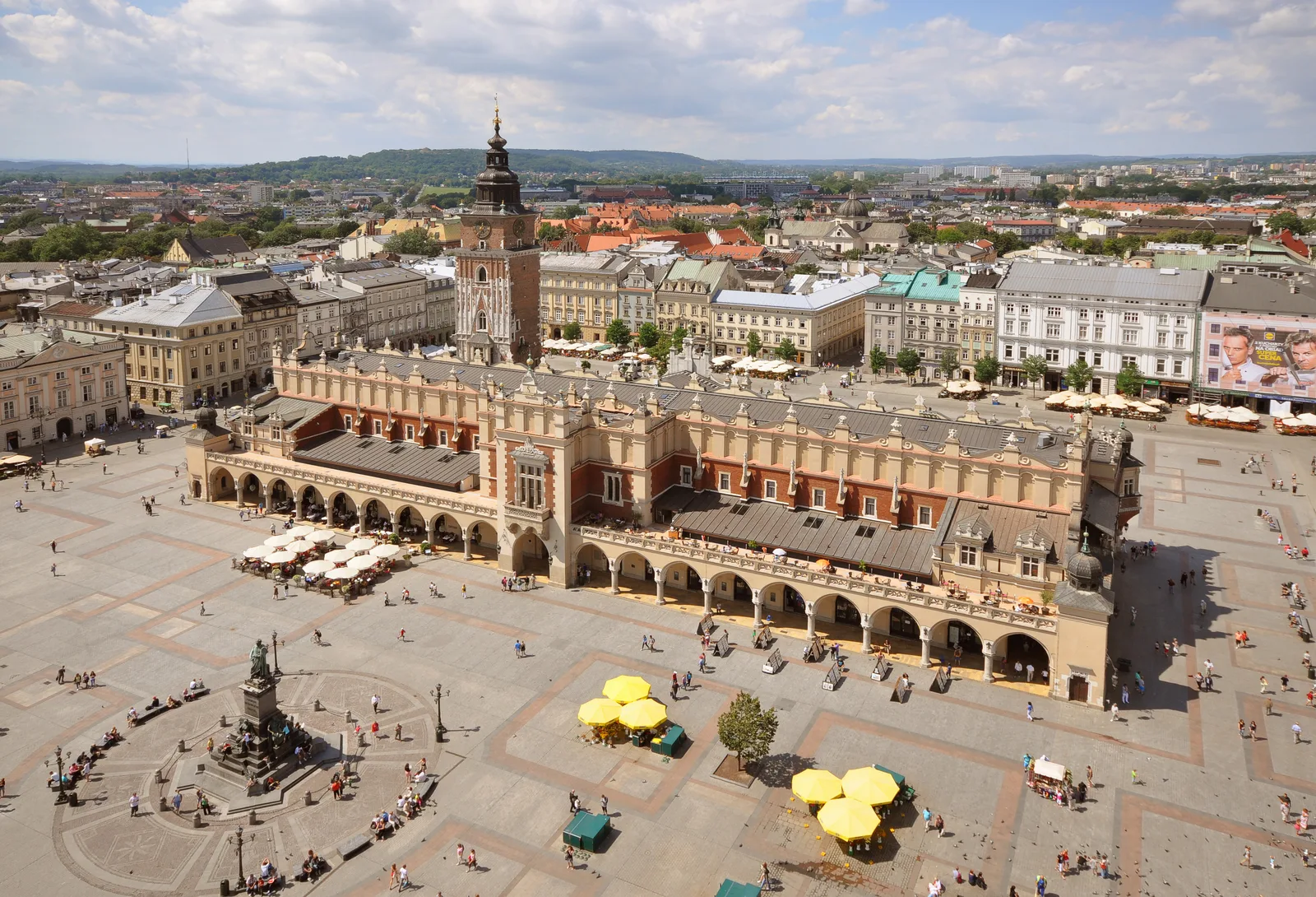
Europe's largest medieval square before the terraces fill: the Town Hall tower, Adam Mickiewicz's statue, pigeons. Buy an obwarzanek (the braided, salted bread ring) from one of the blue carts for a few złoty and eat it walking.
Walk the Sukiennice arcades (amber, wooden boxes, the same souvenirs at every stall), then go below the square when the Rynek Underground museum opens at 10 a.m. Numbers are capped, so book online for a weekday; it is closed the second Monday of each month.
Tourists enter from the south side from 11:30 a.m. Monday to Saturday, and the Veit Stoss altarpiece is opened at 11:50 a.m. The bugler plays the hejnał from the taller tower on every hour.
A working milk bar at Grodzka 43 on the way to Wawel: order at the counter, pay in cash or by card, carry your tray. Pierogi ruskie, żurek (sour rye soup) and a kompot come to about zł 30.
The hill and the arcaded courtyard are free, but each exhibition is a separate timed ticket. Pick the State Rooms (zł 57) for the tapestries and the heads ceiling, or the Crown Treasury (zł 47) for the Szczerbiec sword.
Run by the archdiocese, so it has its own ticket (zł 26, cash or card at the kiosk opposite the door) covering the royal tombs, the climb to the Sigismund Bell and the cathedral museum. Open 9 a.m. to 4:30 p.m. Monday to Saturday and from 12:30 p.m. on Sunday, when the museum is closed.
The park ring where the walls stood, four kilometers all the way round. Walk the west side from Wawel up to the Barbican and St Florian's Gate, then in along Floriańska.
Szewska 23, a few steps off the Rynek, serves pierogi by the plate, boiled or fried: ruskie, with cabbage and mushroom, with duck. No reservations, but the line moves.
At the bottom of Szeroka, the oldest synagogue standing in Poland, now a Muzeum Krakowa branch on Jewish life before 1939. Open 9 a.m. to 5 p.m. Tuesday to Sunday; Monday 10 a.m. to 3 p.m. and free.
Still a working synagogue, at Szeroka 40, with the 16th-century cemetery behind it. Men cover their heads at the door; small admission, cash, closed on Saturdays and Jewish holidays.
Dajwór 18, a photographic record of what remains of Jewish Galicia in the villages around Kraków. Open daily 10 a.m. to 6 p.m., and the ticket is not tied to a time, so it also works as the rain stop.
The round market hall in the middle of the square has a ring of hatches selling zapiekanki: a half baguette under mushrooms and cheese, with whatever you add on top. Endzior is the famous hatch, though any of them is good; eat on the curb.
Cross the Vistula on the Father Bernatek footbridge (the acrobat sculptures, the padlocks) and walk ten minutes to Lipowa 4. Tickets are for a 15-minute entry window and sell out days ahead, so book online.
The 70 empty chairs on Plac Bohaterów Getta mark the ghetto's deportation point, and on the corner the Apteka pod Orłem is the pharmacy Tadeusz Pankiewicz kept open inside it. Small and moving, open 9 a.m. to 5 p.m. Wednesday to Sunday and free on Wednesday.
Back over the bridge to Józefa 14, for Polish cooking (duck, pork knuckle, sour soups) and the house's own flavored vodkas; ask for a tasting board of four before the food. Book a day or two ahead for a weekend.
Alchemia on the square has the candlelit rooms, and Hevre on Meiselsa is a bar inside a former prayer house. Kazimierz is loud until late on Friday and Saturday.
Buses leave the MDA station beside Kraków Główny for the Muzeum Auschwitz stop, about 1 hour 30 minutes. Trains take a little longer and stop 2 kilometers from the gate, so arrive 30 minutes before your tour time.
Entry is free, but every visitor needs a named pass from visit.auschwitz.org, and for most of the day you enter only on a museum educator's 3.5-hour tour of both camps. Bring ID that matches the pass and leave luggage at the hotel, since bags over about 35 by 25 by 15 cm are not allowed in.
If you choose the mine instead, give it the whole day: the Koleje Małopolskie train from Kraków Główny to Wieliczka Rynek-Kopalnia is zł 7 and about 25 minutes. Tours are at booked times, 2 to 3 hours underground at 63°F (17°C) with about 800 steps, 380 of them down at the start.
Świętej Gertrudy 21, just outside the Planty below Wawel, serves old-fashioned Polish dinners: beetroot soup, roast duck with apples, a plate of herring. Book for a weekend.
A last walk around the square under the lit Cloth Hall, then one drink in a cellar bar off the Rynek. The hejnał plays through the night, on the hour.
Loading the map…
Pins are approximate. Tap one for the stop; the directions links open Google Maps.
The practical bits
From the airport
From Kraków Airport (Balice), the Koleje Małopolskie train runs to Kraków Główny in about 20 minutes for zł 20, every half hour, from the platform joined to the terminal by a footbridge; buy at the machine or in the Koleo app. The 300 bus is cheaper on a city ticket but takes 40 minutes or more. A taxi or Bolt to the Old Town is around zł 80 to 100.
What a day costs
About zł 250 to zł 350 a day per person for a milk bar lunch, a sit-down dinner, one or two paid sights and a tram ticket. Day 3 adds the Auschwitz educator tour (zł 150 with a headset; free passes without an educator exist only for the late afternoon) or the salt mine (zł 150 in low season, zł 166 in high, English slots booked online since they sell out) plus transport.
Where to stay
Old Town
Inside the Planty ring, with the Rynek, the churches and Wawel at the bottom. Floriańska and the Rynek bars are loud late into the night, and prices are set for visitors.
Kazimierz
The old Jewish quarter south of the Old Town, ten minutes' walk. Synagogues, Plac Nowy, the bars around it and Starka for dinner.
Podgórze
Across the river by the footbridge: the ghetto's memorials, Schindler's Factory, quiet streets and the Krakus Mound for the view. Residential at night.
Got a day to spare?
Zakopane and the Tatras
Poland's mountain town, two hours by bus from the MDA station. The Gubałówka funicular for the view, Krupówki for oscypek cheese, Morskie Oko lake if you have a full day and good shoes.
Ojców National Park
Limestone cliffs, caves and the castle at Pieskowa Skała, 25 kilometers north. A bus from Kraków takes under an hour; half a day on the valley path is enough.
Nowa Huta
The socialist-realist steel town built in 1949, now a district of Kraków. Tram 4 from the center to Plac Centralny in about 25 minutes; walk the radial avenues and the Arka Pana church.
Worth knowing
Pay in złoty. Shops and restaurants that accept euros set their own rate, and card machines that offer to charge you in your home currency are doing the same thing; press 'PLN'. Cards work everywhere, down to the obwarzanek carts.
Most shops are shut on Sunday by law, apart from a few trading Sundays a year and small owner-run shops such as Żabka. Museums, restaurants and the market halls are unaffected, though St Mary's opens to tourists only from 2 p.m. on Sunday; do your shopping on Saturday.
Tip 10 percent in restaurants, in cash or by telling the server the amount before they put the card through; saying 'thank you' as you hand over the card is taken to mean keep the change.
Tap water is safe to drink. Carry a bottle in summer, when 86°F (30°C) on the Rynek's stone is normal; in winter the problem is the cold and, on still days, the smog, so check the air quality before a long walk.
Several museums are free one day a week: the Rynek Underground on Tuesday (box office only, 10 a.m. to 3 p.m., no booking), Schindler's Factory on Monday (10 a.m. to 3 p.m., no booking, go early) and the Eagle Pharmacy on Wednesday. Schindler's is closed the first Tuesday of the month, and Waystop's hours check flags a stop you place on a closed day.
Things you can ask once it’s in the app
Plans change. Ask Chat and it proposes a reshuffled day you can apply, or just answers the question.
Would Wawel work better in the morning with the Rynek Underground after lunch?Is the Schindler's Factory free Monday worth the line?One of us can't manage the salt mine steps, what else fits day 3?We are staying in Kazimierz and want to see Nowa Huta, which tram gets us there?What should we pack for Kraków in late October?
Questions
Is three days enough for Kraków?
Yes for the city itself, which is two days of walking, with the third day for the memorial or the salt mine. With a fourth day you can do the other one, or Zakopane.
Can we do Auschwitz and Wieliczka on the same day?
Tour companies sell it and it is a long, hard day. Take the earliest bus to Oświęcim and a 3:30 p.m. or later mine slot and it works; better to pick one and come back for the other.
Which day works in the rain?
Day 1: the Rynek Underground, Wawel's interiors and St Mary's are all under cover, and the Galicia Jewish Museum covers a wet morning on day 2. The salt mine is 135 meters below the weather. Waystop's Chat can build a second, wet-weather version of day 1 that sits beside the original; switch between them from the day's menu.
What must we book before we fly?
The Auschwitz pass (released at noon, 90 days out), Schindler's Factory (up to 90 days out, and it sells out), and Wawel's exhibition tickets, which are timed, capped each day and sold online about a month ahead (open 9 a.m. to 5 p.m. Tuesday to Sunday, 10 a.m. to 4 p.m. Monday). The Rynek Underground has capped numbers, so book a weekday online; St Mary's can be bought on the day most of the year.
Add your dates, your hotel and who’s coming, then ask Chat to change anything: it proposes the edit and you tap Apply. Want a long lunch instead of a museum? Just ask. Every place is checked against Google Maps before it lands on your day, and Chat can tell you when to leave for the next stop. Going on to another city? Build a multi-city trip.