Three days in the old royal capital: the peninsula's temples and the palace on foot after the dawn alms round, Kuang Si Falls before the vans arrive and an afternoon with the weavers, then a slow boat up the Mekong to the Pak Ou caves.
November to February is dry, clear and cool in the mornings, and the busiest. March and April are hot and hazy from field burning; the April New Year (Pi Mai) is a water fight and hotels fill. June to September is the rainy season: green hills, brown rivers, afternoon downpours and the Kuang Si pools lose their color.
Where to base yourself
Sleep on the peninsula itself, between the Royal Palace and Wat Xieng Thong, and everything on day 1 is a walk; the alms round passes the door. The Mekong bank south of the palace (Ban Wat That) is quieter and cheaper. Across the Nam Khan, the Ban Phan Luang side is village-quiet and reached by the bamboo bridge in the dry season.
Getting around
The peninsula is a kilometer long, so walk it. Bicycles rent for around ₭20,000 to ₭30,000 a day and suit the flat streets; tuk-tuks are the taxi, and you agree the fare before you get in (₭30,000 to ₭50,000 across town). Loca is the local ride app and works for the station and the airport, and a free pink tuk-tuk runs from Ock Pop Tok to its town shop near 3 Nagas between 9:30 a.m. and 8:30 p.m. Everything is paid in kip, in cash, with notes of ₭100,000 the largest.
Monks walk Sakkaline Road at first light, from about 5:30 a.m. in summer and 6:30 a.m. in winter. Watch from across the street with shoulders and knees covered and no flash, and do not buy rice from touts to offer.
The lanes behind the Royal Palace, busiest from 6 a.m. and gone by 11 a.m.: river weed, buffalo skin, frogs, sticky rice in baskets. Breakfast is khao soi (minced pork and tomato on rice noodles) at the noodle shop across from Wat Sene, open mornings only.
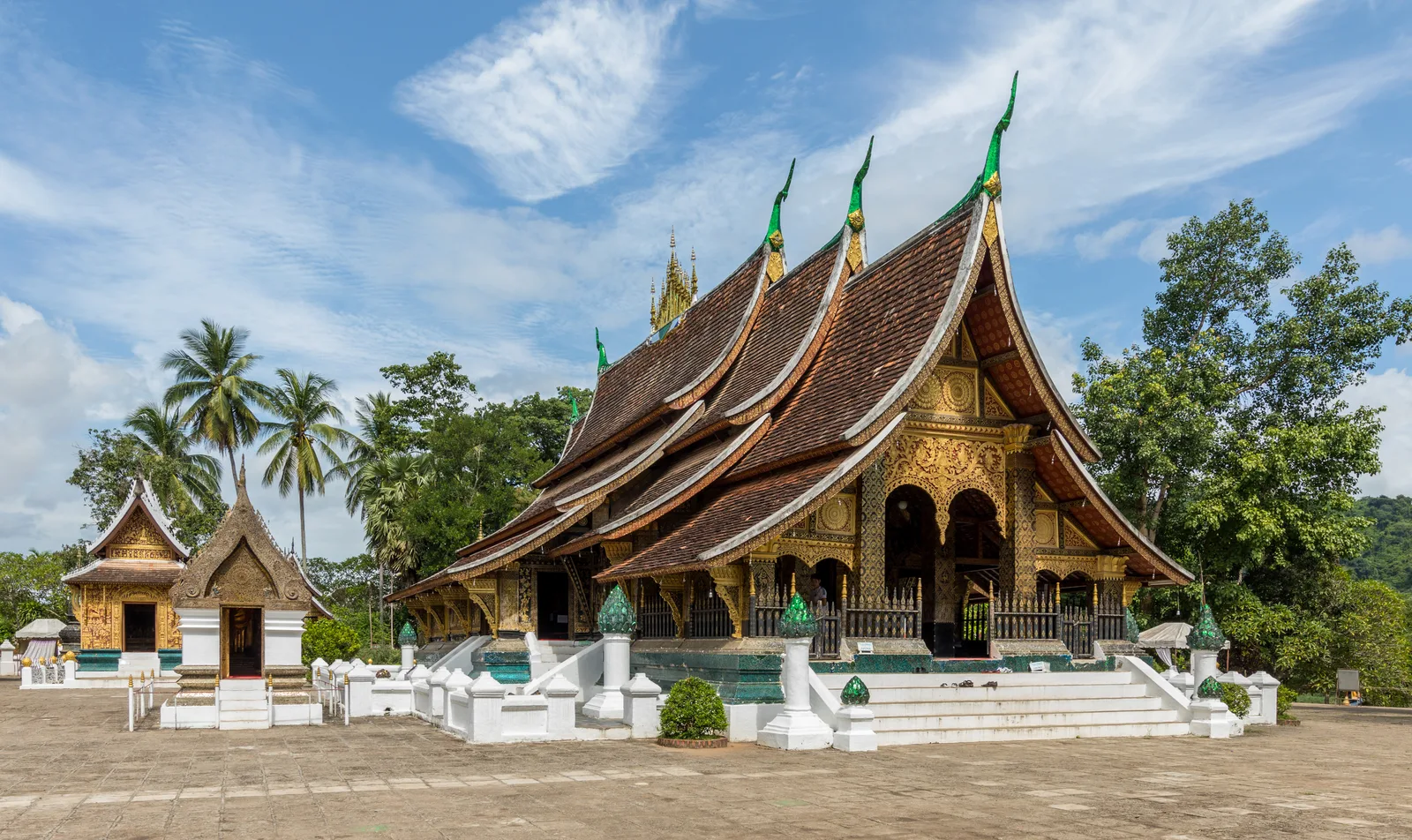
The 1560 temple at the tip of the peninsula, with the tree of life mosaic on the back wall of the sim and the gilded funeral carriage hall. It opens at 8 a.m. and is empty for the first half hour; walk back along Sakkaline Road past Wat Sene and Wat Nong.
The 1904 palace, kept as the king left it in 1975. Bags, cameras and phones go in the free lockers, so photograph Haw Pha Bang and the grounds instead.
Lao food explained, on the Nam Khan side: order the tasting platter of jeow dips with sticky rice and river weed, and an or lam stew. It is popular, so arrive at noon or book a table.
The watermelon stupa and the oldest working temple in town, ten minutes south of the palace and quiet in the afternoon heat. A small ticket at each; rest at a cafe on Sisavangvong Road afterwards.
About 300 steps to the stupa and the view over both rivers. Sunset is around 6 p.m. most of the year and the top is crowded, so climb the quieter Nam Khan side from Wat Siphoutthabath and come down the palace side into the night market.
Sisavangvong Road closes to traffic from 5 p.m. for textiles, paper lamps and Hmong embroidery. Eat in the food alley at the palace end: grilled Mekong fish stuffed with lemongrass, Lao sausage, or a plate from the vegetarian buffet.
Leave town at 7:30 a.m. for the 45-minute ride, because the gates open at 8 a.m. and the minivans arrive from about 10:30 a.m. Swim the turquoise lower pools first, then take the steep left-hand trail to the top of the 50-meter drop.
Free the Bears' enclosures of moon bears saved from bile farms, just inside the falls entrance and covered by the same ticket. Feeding and enrichment happen through the morning.
Ask the driver to drop you at Ock Pop Tok in Ban Saylom, two kilometers south of town on the Mekong, on the way back. The terrace over the river serves Lao and Western plates from 7:30 a.m. to 8 p.m.; try the Mekong fish laap.
Free tour of the silk process from worm to loom, with master weavers at work, natural dye pots in the garden and demonstrations at 11:30 a.m. and 4:30 p.m. Half-day weaving and dyeing classes need booking a day or two ahead.
The five-tiered roof and the golden relief on the front veranda, next to the palace. A small ticket; this is where the Pha Bang Buddha is paraded at New Year.
The row of terraces over the Mekong between the palace and the peninsula tip. Order mok pa (fish steamed in banana leaf), Luang Prabang sausage and a jeow bong chili paste with sticky rice; no booking needed, so pick the one with the fewest empty tables.
Shared longboats leave about 8:30 a.m. from the pier by Saffron Coffee on Khem Khong road and take two hours upstream past fishermen and buffalo. Bring a hat, as there is little shade on deck.
Two caves at the mouth of the Nam Ou, open 8 a.m. to 5 p.m., hold thousands of Buddha figures left over four centuries. Tham Ting is steps from the pier; the upper cave, Tham Theung, is a 15-minute climb and dark inside, so bring a flashlight.
The whisky village stop on the way back: stills of lao-lao rice spirit, jars with snakes and scorpions in them, and weaving sold from the houses. A tasting is free and it is polite to buy a small bottle; the boat waits about 20 minutes.
The training restaurant run by a social enterprise for young Lao, a few minutes from the pier. Order the khaiphaen itself, crispy Mekong river weed with sesame, and the buffalo laap.
A small exhibit on the bombs still in the fields of Laos and the teams clearing them, with a short film. It is behind the Souphanouvong monument, open 8 a.m. to 4 p.m., free with a donation box.
Rebuilt by one family every November after the river drops and taken by the current around May, with a toll of around ₭7,000 that pays for it. Cross below Wat Siphoutthabath and walk the lane of weavers on the Ban Phan Luang side; in the rainy season there is no bridge and Dyen Sabai runs a free boat.
Where the Nam Khan meets the Mekong, below Wat Xieng Thong. Steps lead down to the point, where you can sit and watch the boats come in; it is free and quieter than Phousi.
Lao barbecue (sindad) across the bamboo bridge: a charcoal pot at your table, a dome for the meat and a moat of broth for the greens and noodles. Cushions on the floor and lanterns in the trees; book for a table at the edge.
₭60,000
Loading the map…
Pins are approximate. Tap one for the stop; the directions links open Google Maps.
The practical bits
From the airport
Luang Prabang International Airport (LPQ) is four kilometers from the old town. Lao Airlines, Bangkok Airways, Vietnam Airlines and AirAsia fly in from Bangkok, Hanoi, Chiang Mai and Kuala Lumpur. Buy a taxi at the fixed-fare desk in arrivals, around ₭50,000 to ₭100,000 a car, 15 minutes to any hotel. From Vientiane the Laos-China Railway takes about two hours, with trains between about 7:30 a.m. and 4 p.m.; the station is 12 to 15 kilometers south of town, a shared minivan or Loca ride of 25 minutes.
What a day costs
About ₭500,000 to ₭800,000 a day per person (roughly US$22 to US$36) for noodles and a sit-down dinner, the ₭20,000 to ₭60,000 tickets and a shared tuk-tuk. The Kuang Si and Pak Ou days each add ₭50,000 to ₭100,000 of transport, with a shared longboat to Pak Ou around ₭75,000 round-trip; a private boat or tuk-tuk for four adds around ₭300,000 split between you. A Beerlao on the riverbank is around ₭25,000.
Where to stay
The peninsula
Wat Xieng Thong to the palace, between the two rivers. Temples, guesthouses in old teak houses, the alms round at dawn and the night market at dusk. Quiet by 10 p.m.
Mekong bank and Ban Wat That
South of the palace along the river: sunset terraces, boutique hotels in French villas and the stairs to Wat That. A few minutes from everything and cheaper than the tip.
Across the Nam Khan
Ban Phan Luang and the lanes behind Dyen Sabai: weavers, gardens and a view back at the town. Reached by the bamboo bridge in the dry season and by boat or a long walk round when the river is high.
Got a day to spare?
Nong Khiaw
Limestone cliffs over the Nam Ou, the Pha Daeng viewpoint climb and kayaks. Three to four hours by minivan; most people stay a night rather than go and return.
Vang Vieng by train
About an hour on the Laos-China Railway. Blue lagoons, caves and the Nam Song by kayak; back on an evening train or stay the night.
Tad Sae waterfall
Limestone cascades 15 kilometers south-east, reached by tuk-tuk and a short boat ride. Only worth it in and just after the rainy season; it dries to a trickle by February.
Worth knowing
Bring cash. Kip is the only currency for tickets, tuk-tuks and markets, ATMs give at most ₭2,000,000 or so per withdrawal with a fee, and the rate moves; at the time of writing a dollar is about ₭22,000.
The Royal Palace is open 8 to 11:30 a.m. and 1:30 to 4 p.m. and closed Tuesdays, so put it in the morning of a non-Tuesday and bring nothing you mind leaving in a locker. Waystop's hours check flags a palace stop placed on a Tuesday or in the midday closure.
Cover knees and shoulders in every temple and the palace, and take your shoes off at the sim door. A sarong in your bag solves it on hot days, and the palace lends them at the door.
Agree every tuk-tuk fare before you sit down, and settle the Kuang Si price with the waiting time included. A shared tuk-tuk to the falls is around ₭50,000 a seat and a private one around ₭300,000 for the morning; the shared ones fill fastest between 8 and 9 a.m. at the stand opposite the night market.
Most nationalities need a visa: apply for the Lao eVisa online a few days before, or pay on arrival at the airport and the Vientiane border in dollars.
Things you can ask once it’s in the app
Plans change. Ask Chat and it proposes a reshuffled day you can apply, or just answers the question.
The palace is closed on Tuesdays and we arrive on a Monday, how should we order the three days?How do I buy the train from Vientiane on the LCR app?Is Kuang Si worth it in August when the water is brown?We have a 6-year-old, which day is hardest for her?What should I wear for the alms round and the temples?
Questions
Is three days enough for Luang Prabang?
Yes for the town, the falls and the river. A fourth day would fit a Living Land rice-farm morning and a cooking class, and a fifth the minivan to Nong Khiaw and its karst.
How do I get here from Vientiane?
The Laos-China Railway: about two hours, six trains a day, second class around ₭330,000. Buy in the LCR Ticket app (email sign-up, card payment, a ₭10,000 fee) when sales open a few days before, or in cash at the station. Both stations are 12 to 15 kilometers out of town; shared minivans are around ₭40,000.
Which day works in the rain?
Day 1: the palace, the morning market and the night market are under cover or soon over, and temples are fine wet. Keep Kuang Si for a clear morning, since the pools turn brown after heavy rain. Ask Waystop's Chat for a rain version of day 2 and it proposes one as a card; accept it and switch to it from the day's menu.
Can I take part in the alms round?
You can, with a basket of sticky rice bought from a market stall the evening before, kneeling or sitting on a low stool with your head below the monks. Most visitors do better watching from across the road; the ceremony is for the town, and the cheap rice sold by touts at dawn makes the monks ill.
Add your dates, your hotel and who’s coming, then ask Chat to change anything: it proposes the edit and you tap Apply. Want a long lunch instead of a museum? Just ask. Every place is checked against Google Maps before it lands on your day, and Chat can tell you when to leave for the next stop. Going on to another city? Build a multi-city trip.