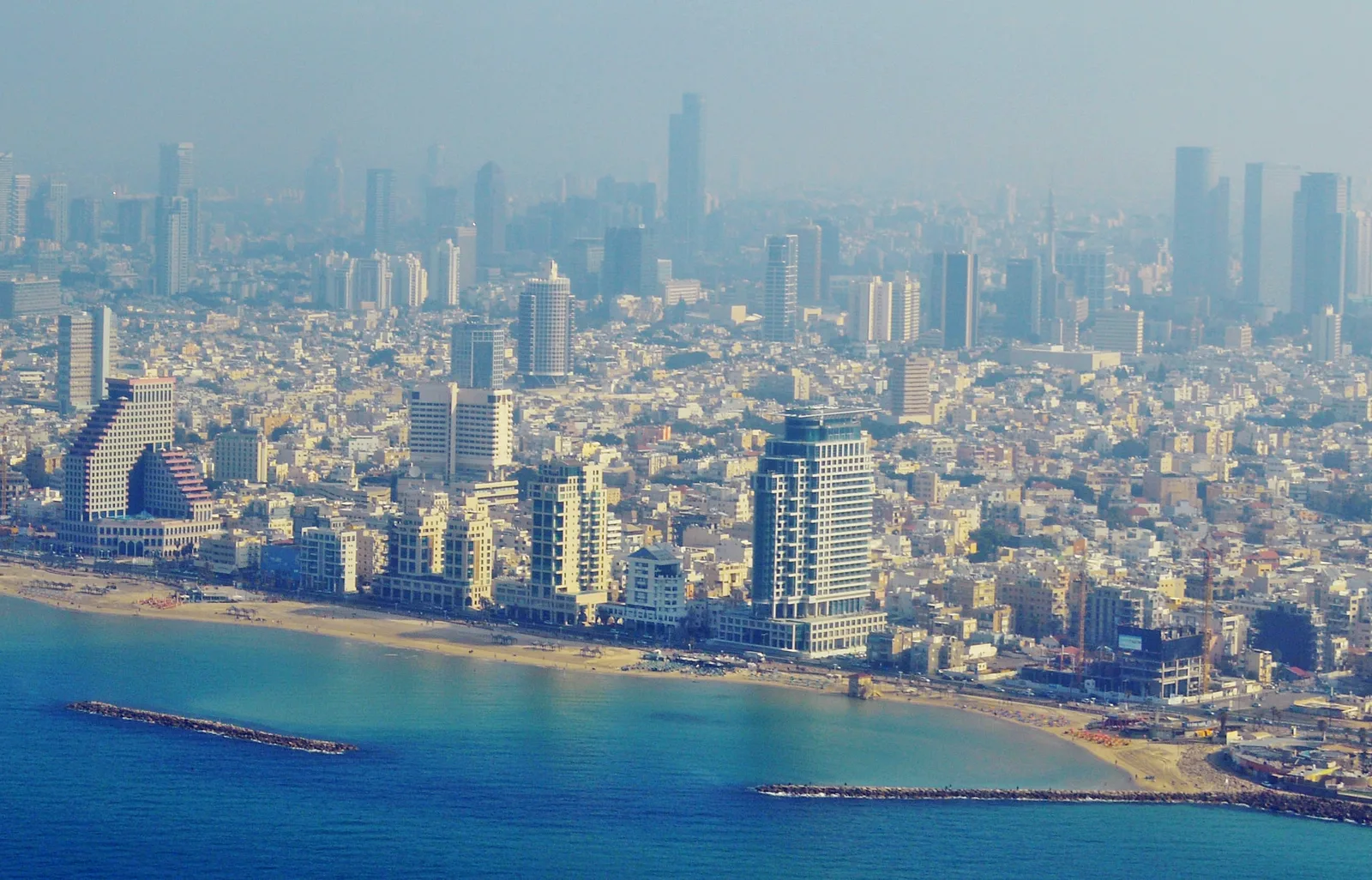
Two days on the coast: Jaffa's hummus and flea market, the Bauhaus boulevards, the Carmel and Levinsky markets and an afternoon on Gordon beach. Then the fast train to Jerusalem's Old City. Tap a bank card on everything, and plan around Shabbat.
October to November and March to May are the easy months, at 68 to 81°F (20 to 27°C). July and August reach 90°F (32°C) with heavy humidity, and December to February bring short, hard rain between sunny days. Passover and the High Holidays shut shops and transport for days. Check your government's travel advice the week you fly.
Where to base yourself
Neve Tzedek or the streets off Rothschild for the walkable middle; the beach strip between Gordon and the Namal for mornings in the sea; Jaffa for the port and the flea market's bars. Every hotel has a protected room or a stairwell shelter; ask at check-in where it is.
Getting around
Buses, the Red Line light rail and Israel Railroads all take a tap of a contactless bank card or a Rav-Kav; cash is not accepted on buses. Moovit is the app locals use for live times; HopOn and the Rav-Kav app hold the card on your phone. Day 1 and Day 2 are walks with one bus each; Day 3 is one train each way. From Friday afternoon to Saturday night buses and trains stop; the city's free weekend minibuses, sherut shared taxis along Ben Yehuda and Gett taxis keep running.
The hummus Jaffa lines up for, served from 8 a.m. Sunday to Friday until the pot is empty, usually early afternoon. Order the masabacha, warm with whole chickpeas, and eat it with raw onion; closed Saturday.
Shuk HaPishpeshim's stalls and shops open around 9 a.m. to 10 a.m.; the junk is at the sidewalk end, the design shops and bars on the lanes behind. Shops close Saturday and early on Friday.
Up the clock tower square to St Peter's, the Wishing Bridge and the HaPisgah garden for the view north along the whole coast, then down to the port's warehouses and fishing boats.
The seafront path from the port past Charles Clore Park to the Jerusalem Beach boardwalk is three kilometers of flat walking; cut inland at the old train station (HaTachana) for Neve Tzedek.
The first neighborhood outside Jaffa's walls, now low houses and boutiques. Dallal's courtyard for lunch if it is open; Anita, at the far end of the street, for the ice cream everyone is carrying.
Four thousand Bauhaus and International Style buildings make up the UNESCO White City; the best run is Rothschild from Herzl to Habima. The Bauhaus Center on Dizengoff Street runs a guided walk on Friday mornings (around ₪100, book online), or rent its audio guide on other days.
Rothschild's central path has a kiosk every few blocks; take a coffee or a beer to a bench and watch the city go home. Habima Square's sunken garden is at the top end.
Eyal Shani's loud, no-reservation place beside the Great Synagogue, two blocks off Rothschild. The whole roasted cauliflower and the day's fish; the line builds after 8 p.m., so arrive at opening.
Florentin's spice street: Balkan and Persian grocers, dried fruit and nuts by weight, a gazoz (syrup soda) from Café Levinsky 41 at the corner. Closed Saturday, quiet before 9 a.m.
Shuk HaCarmel runs from Allenby to the sea end of HaCarmel Street: fruit, halva, juice, cheap clothes, the Yemenite Quarter's lanes to the side. Busiest on Friday morning, shut on Saturday.
The sabich stand at the corner of Frishman and Dizengoff, a fifteen-minute walk north: fried eggplant, egg, tahini and amba in a pita, eaten standing. HaKosem on Shlomo HaMelech is the falafel alternative.
Israeli art and the angled concrete of the Herta and Paul Amir building, a 25-minute walk or one bus east on Shaul HaMelech. Open 10 a.m. to 6 p.m. Monday to Wednesday and Saturday, to 9 p.m. Thursday and 2 p.m. Friday; closed Sunday.
Take a bus or taxi back to the sea. Lifeguards sit from 7:15 a.m. to about 4:45 p.m. in season (mid-April to early October) and swimming is barred when the stand is empty; rent a chair and listen for the matkot paddles that never stop.
Dizengoff Square's fountain and the 1930s round-cornered blocks, then the promenade north past Hilton beach to the Tel Aviv Port's wooden deck for sunset: 5:30 p.m. in October, closer to 7:45 p.m. in June.
Sharon Cohen's seafood bar on Ben Yehuda, ten minutes from the port; reserve a day or two ahead and order the crudo and whatever is on the grill. Sarona Market's food hall is the no-reservation alternative across town.
From Tel Aviv HaHagana or Savidor Center, about 35 minutes, every half hour, around ₪24 each way; tap a Rav-Kav or a contactless bank card at the gate. No trains from Friday early afternoon until Saturday night.
Take the Red Line light rail from Navon to City Hall (about six stops, the same card), then walk downhill to Jaffa Gate. The loop through the Armenian, Jewish, Muslim and Christian quarters passes the Cardo, the Western Wall, the souq and the Holy Sepulchre; wear proper shoes on the stone and steps.
Free and open all hours, with a security check. Shoulders and knees covered, men take a free paper kippah, and the plaza is split into men's and women's sections; do not photograph on Saturday.
Golgotha and the tomb under one roof, shared by six churches. Free; cover shoulders and knees, and expect a 30 to 60 minute line for the Edicule by mid-morning, shorter before 9 a.m.
Two light rail stops or a 25-minute walk back along Jaffa Road. Eat Azura in the Iraqi market for stuffed vegetables and kubbeh soup, then carry away a Marzipan rugelach; the market is frantic on Friday before closing and shut on Saturday.
Yad Vashem is free but must be booked online ahead (ages 10 and up); take the light rail to Mount Herzl, then the shuttle. It closes early on Tuesday and Friday and all day Saturday, so on those days take the Israel Museum (₪62) for the Dead Sea Scrolls.
Light rail to Navon, the half-hourly train to HaHagana, and a last walk to Jaffa along the seafront as the lights come on. Allow 90 minutes door to door.
Mismatched furniture in the flea market lanes, home cooking and a long evening; or Onza on Rabbi Pinchas Street for Turkish-leaning plates and a loud room. Both fill after 8:30 p.m. on a Thursday.
₪140
Loading the map…
Pins are approximate. Tap one for the stop; the directions links open Google Maps.
The practical bits
From the airport
From Ben Gurion (TLV), the train from the Terminal 3 station reaches Tel Aviv Savidor Center or HaHagana in about 18 minutes for ₪13.50, every half hour and through the night Sunday to Thursday; tap a bank card. No trains from Friday afternoon to Saturday night. The taxi stand on Terminal 3's arrivals level charges a fixed ₪150 to central Tel Aviv, more after 9 p.m. and on Shabbat; order through the Gett app or the kiosk, not from touts.
What a day costs
About ₪250 to ₪400 a day per person. Hummus or a sabich is ₪30, a museum ₪55 to ₪62, the Jerusalem train ₪24 each way, a beach chair ₪15 to ₪20, and a sit-down dinner with wine ₪150 to ₪200.
Where to stay
Neve Tzedek and Rothschild
Low houses, boutiques, the Bauhaus boulevard and the kiosks. Walkable to Jaffa and the beach, and a good base for a first visit.
Gordon to the Namal
The hotel strip along the sea, the marina, the port's deck and the Saturday crowds. Mornings in the water, a long walk to anywhere else.
Jaffa and Florentin
The flea market, the port, the Levinsky spice street and the bars that open late. Cheaper and louder; the Ajami hummus is on your doorstep.
Got a day to spare?
Caesarea and Haifa
Herod's harbor and the Roman theater at Caesarea (a taxi from Binyamina station), then on to Haifa for the Bahá'í terraces and the German Colony; the train north from Savidor is about an hour to Haifa.
The Dead Sea and Masada
A long organized day: two hours each way by Route 90 through the Jordan Valley, which the FCDO excepts from its West Bank advice. Masada's cable car or the Snake Path at dawn, then a float at Ein Bokek. Book the tour the week before.
Akko
The Crusader halls under the Old City, the Templar tunnel and a fish lunch at the harbor; about 1 hour 45 by train from Savidor and a 15-minute walk from the station. Not on Saturday, when the trains do not run.
Worth knowing
Apply for the ETA-IL before you fly if your passport is visa-exempt (UK, EU, US and most others): ₪25 online at israel-entry.piba.gov.il, mandatory since January 2025 and valid for two years. Only the official site; the copies charge ten times as much.
Shabbat runs from Friday afternoon to Saturday after dark: buses and trains stop, most shops and the markets close, and the museums and many restaurants stay open. Put the beach, the museum and the Namal on a Saturday, and the markets and Jaffa on a weekday.
A Friday night dinner is the week's main meal and restaurants book out; reserve on Wednesday. Kosher places close Friday evening to Saturday night; much of Tel Aviv is not kosher and does not.
Tip 12 to 15 percent in restaurants, in cash where you can; it is often not on the card machine. Taxi drivers are not tipped. Tap water is safe and the summer humidity means you drink a lot of it.
Allow three hours at Ben Gurion on the way home: the security questions before check-in are normal, polite and long, and more so if your passport has other Middle East stamps. Answer plainly.
Things you can ask once it’s in the app
Plans change. Ask Chat and it proposes a reshuffled day you can apply, or just answers the question.
We land on a Friday evening, what can we actually do before Sunday?Swap Yad Vashem for the Israel Museum on day 3, it's a TuesdayIs Abu Hassan vegan, and what else is good in Jaffa for breakfast?How do we get from the Tel Aviv Museum of Art back to Gordon beach?What do the US and UK travel advisories say about Israel?
Questions
What do the travel advisories say about Israel right now?
As last checked on October 10, 2026, the UK FCDO advises against all travel to Gaza, the area within 500 meters of its border, parts of the far north and the Golan, and some northern West Bank governorates, and against all but essential travel to most of the rest of the West Bank. It has no advice against Tel Aviv or Jerusalem, but warns of rocket and drone attacks and possible disruption at Ben Gurion. The US State Department has listed Israel at Level 3, Reconsider Travel, with higher levels for some areas. Read both pages the week you fly, install the Home Front Command app, and check that your insurance covers it.
Which day works in the rain?
Day 2: the Carmel Market is largely covered and the Tel Aviv Museum of Art takes an afternoon; swap the beach for the Sarona Market food hall. Waystop's rain plan can add that version of the day for you to switch to.
What stops for Shabbat, and what still runs in Tel Aviv?
Trains and buses stop from Friday early afternoon until Saturday after dark; the Jerusalem day has to be Sunday to Thursday. In Tel Aviv the beaches, the museum, the Namal, Sarona and most non-kosher restaurants stay open, and the city's free weekend minibuses, sherut taxis and Gett taxis keep moving.
Do I need a visa?
Visa-exempt passports (UK, EU, US, Canada, Australia) need the ETA-IL instead: ₪25, applied for online before departure, valid two years for stays of up to 90 days. Apply a week ahead; most approvals arrive within a day or two.
Add your dates, your hotel and who’s coming, then ask Chat to change anything: it proposes the edit and you tap Apply. Want a long lunch instead of a museum? Just ask. Every place is checked against Google Maps before it lands on your day, and Chat can tell you when to leave for the next stop. Going on to another city? Build a multi-city trip.