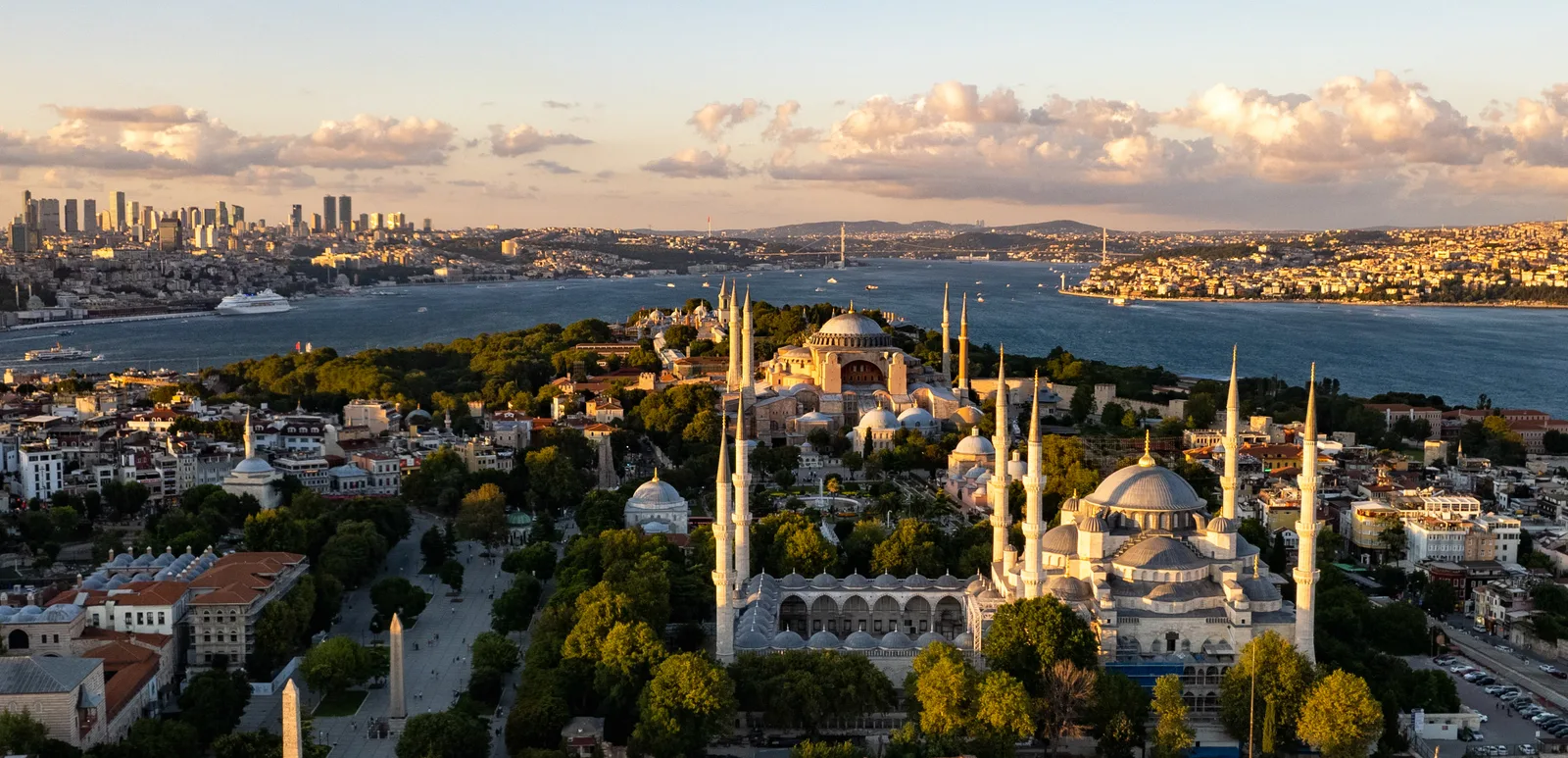
Four days on both sides of the water: the Sultanahmet monuments before the coaches, the bazaars and a Bosphorus ferry at sunset, Galata and a Beyoğlu meyhane, then the Golden Horn and the Asian side. One Istanbulkart does every tram, ferry and metro.
April to early June and mid-September to October: 61 to 77°F (16 to 25°C), dry enough, long evenings on the ferries. July and August sit near 86°F (30°C) with humidity and lines at everything in Sultanahmet. November to March is wet (December is the rainiest month) and 39 to 48°F (4 to 9°C), with a few days of snow; the sights are empty and hotels are half price. The two Eid holidays close the bazaars for several days.
Where to base yourself
Sultanahmet puts the big four on foot but empties after dark and the restaurants are aimed at you. Karaköy or Galata for cafés, the bridge and a tram or ferry to everything; Cihangir for Beyoğlu nights and views; Kadıköy on the Asian side for local life and a 20-minute ferry commute that is the best part of the day.
Getting around
Buy an Istanbulkart (₺165 for the card) at any Biletmatik machine and load it; one card can pay for a group, tapped once per person. A ride is ₺46.20 on metro, tram and bus since the July 2026 rise, ferries ₺53 to ₺65. The T1 tram links Sultanahmet, Eminönü, Karaköy and Kabataş; Şehir Hatları ferries cross the Bosphorus every 20 minutes; the Marmaray train runs under it from Sirkeci to Üsküdar in four minutes. Taxis are cheap but call one with the BiTaksi app and insist on the meter.
Free, through the visitors' entrance on the Hippodrome side; the 8:30 a.m. to about noon window never collides with a prayer closure. Shoulders and knees covered, women cover their hair (scarves are lent at the door), shoes off into a bag.
Since January 2024 foreign visitors pay €25 and enter by a separate route to the upper gallery, where the Deesis mosaic and the view down the nave are. It is closed to visitors at each prayer time and for most of Friday midday, and the Museum Pass is not valid.
Tickets are sold at the door on Yerebatan Caddesi, card or Istanbulkart only, with no official online sale, so go before 10:30 a.m. or accept the line. The Medusa heads are at the far end; a separate Night Shift ticket (₺3,000) runs 7:30 p.m. to 10 p.m. with a light show.
Divan Yolu 12, since 1920, open 10:30 a.m. to 10:30 p.m.: köfte with piyaz (white bean salad), pickled peppers and bread, around ₺600. Ignore the look-alike köfte shops either side.
Closed Tuesday. One ₺2,750 ticket covers the palace, the Harem and Hagia Irene, sold at the gate or covered by the Museum Pass; do the Harem first, then the Treasury and the fourth courtyard terraces over the Bosphorus.
The Egyptian obelisk and the Serpent Column on the old chariot track, then the Arasta's quiet arcade of carpet and tile shops behind the Blue Mosque. Prices are fixed here, which is a rest after the Grand Bazaar.
A tram stop or a 15-minute walk downhill. Lamb kebabs from Urfa and a terrace across the Golden Horn to the Galata Tower; book a window table and ask for the pistachio kebab and a katmer to finish.
Closed Sunday and on public and religious holidays; opens 9 a.m., and shops are covering up by 6:30 p.m.. Enter at the Nuruosmaniye gate, find the Cevahir Bedesten at the center for antiques, and bargain on everything except food.
Ten minutes uphill through the Sahaflar book bazaar to Sinan's masterpiece, free and open to visitors from about 9 a.m. to 6 p.m. except at prayer times (Friday only after 2:30 p.m.). The terrace behind it has a free view of the Golden Horn.
Walk down to the water on the west side of the Galata Bridge. Grilled mackerel in half a loaf with onion and lettuce from the rocking boats, a squeeze of lemon and a cup of turşu suyu (pickle juice) from the cart, around ₺200 to ₺260.
Up a hidden staircase from the Hasırcılar street market, on a terrace above the shops, lined with Iznik tiles inside and out. Free, with the same prayer-time closures as every mosque.
Open every day including Sunday, about 9:30 a.m. to 7 p.m.: pul biber, sumac, dried apricots and Turkish delight by weight. Taste before you buy, and look for the line at Kurukahveci Mehmet Efendi, the coffee roaster at the west corner.
From the Eminönü pier, 15 minutes across the Bosphorus for about ₺53 on the Istanbulkart. Sit on the open deck on the right for Topkapı's point, the Maiden's Tower and the Asian shore.
Walk south from the Üsküdar pier along the water for 20 minutes to Salacak. The whole old city skyline sits across the strait and the sun goes down behind it, from the tea gardens where Istanbul comes to watch.
Selmani Pak Caddesi 9, up from the Üsküdar pier, since 1933 and open to 10:30 p.m.. Point at the steam counter for hünkar beğendi, Elbasan tava or olive-oil vegetables, then kaymaklı ayva (quince with clotted cream); go back by ferry or the Marmaray train to Sirkeci.
Cross the bridge on foot from Eminönü between the fishermen, then have a pistachio baklava and a Turkish coffee standing at Güllüoğlu on Rıhtım Caddesi, open from 7 a.m..
Open daily 8:30 a.m. to 11 p.m. for €30, with an elevator to the sixth floor and stairs for the last bit; the Museum Pass covers it in daytime hours. The line is small before 10:30 a.m..
Serdar-ı Ekrem for the design shops and the Doğan Apartmanı courtyard, the Camondo Stairs' art nouveau curve, and the music shops of Galip Dede Caddesi up toward Tünel. Steep in both directions.
The turquoise-tiled room on Kemankeş Caddesi, a Bib Gourmand in 2026; at lunch it is an esnaf lokanta where you order from the day's trays. Zeytinyağlı vegetables, a stew and rice, with no booking needed at midday.
Closed Monday. Renzo Piano's building on the Galataport quay, ₺1,000, with the Turkish collection upstairs and the roof terrace over the Bosphorus; an hour and a half is plenty.
The Tünel funicular from Karaköy, running since 1875, climbs to Beyoğlu in 90 seconds for one Istanbulkart fare. Then walk the 1.4 kilometers of İstiklal to Taksim: the red tram, the Çiçek Pasajı arcade, St Anthony's church and the Balık Pazarı side streets.
Pera Museum (closed Monday, ₺300) has Osman Hamdi Bey's Tortoise Trainer and the Orientalist paintings. Or drop downhill into Çukurcuma's antique shops and Cihangir's cafés, where the neighborhood's cats are at their fattest.
Yakup 2 or Sofyalı 9, a few doors apart: cold meze from the tray, then hot ones, then a fish, with rakı and water. Book on Friday and Saturday; Nevizade Sokak off the Balık Pazarı is the louder version with tables in the street.
Closed to visitors on Friday; otherwise 9 a.m. to 6 p.m. with pauses at prayer times. Byzantine mosaics and frescoes, reopened as a mosque in 2024 with a €20 foreigner ticket (the Museum Pass is not valid), and women cover their heads.
Downhill to the Ecumenical Patriarchate, the seat of the Orthodox church since 1601, where the small Church of St George is open to visitors most mornings, free and in modest dress. The red-brick Phanar Greek Orthodox College towers over the quarter from the hill above.
The painted houses on Kiremit Caddesi and the Merdivenli Yokuş steps, the cafés that have moved in, the synagogues behind plain doors. On the shore, the Bulgarian St Stephen church is cast entirely from iron, shipped from Vienna in 1898 and free to step inside.
The Golden Horn ferry from Fener or Balat pier runs to Eminönü about hourly; change there to the Kadıköy boat, 20 minutes across for about ₺65. If the timing is wrong, the 99 bus to Eminönü does the first leg in 20 minutes.
Güneşlibahçe Sokak 43 in the market, open daily from 11 a.m.. Regional Anatolian cooking: point at the trays and leave room for the candied pumpkin with tahini.
The fishmongers, pickle shops, olive counters and the old Baylan patisserie around Güneşlibahçe and Serasker streets, then the bar lanes of Kadife Sokak. This is where the city shops, at roughly half Sultanahmet's prices.
Fifteen minutes' walk through quieter streets to the Moda shore: ice cream on Moda Caddesi, the tea garden at the point and sunset over the old city from the sea wall. The nostalgic tram loops back to the pier if your feet are done.
One of the grills off the fish market for a last meal, then the 20-minute ferry back to Eminönü or Karaköy with the lit-up skyline ahead. Boats run late into the evening, with the Marmaray from Ayrılık Çeşmesi as the fallback.
Loading the map…
Pins are approximate. Tap one for the stop; the directions links open Google Maps.
The practical bits
From the airport
From Istanbul Airport (IST) the M11 metro runs to Kağıthane and Gayrettepe in about 35 to 40 minutes for a standard Istanbulkart fare; change to the M2 for Taksim or to Vezneciler for Sultanahmet, about an hour door to door. The Havaist coach is ₺470: HVL-9 to Taksim in about 90 minutes, or HVL-1 to Aksaray and two tram stops to Sultanahmet, since there is no longer a direct Sultanahmet line. A metered taxi is 60 to 90 minutes. From Sabiha Gökçen (SAW) the M4 metro reaches Kadıköy and the ferries; the Havabüs to Taksim is around ₺450 to ₺485.
What a day costs
About ₺3,500 to ₺6,000 a day per person (roughly €70 to €120), hotel excluded. Day 1's tickets alone come to about ₺5,800 with Hagia Sophia, the cistern and Topkapı. A lokanta lunch is ₺400 to ₺600, a fish sandwich ₺250, a meyhane dinner with rakı ₺1,500 to ₺2,500, and a day of trams and ferries ₺200 to ₺300.
Where to stay
Sultanahmet
The four great sights on foot and the tram at the door. Beautiful at 7 in the morning, dead and overpriced at 9 at night.
Karaköy and Galata
Coffee, galleries, the bridge to the old city and the funicular up to Beyoğlu. The most convenient base for this plan.
Kadıköy and Moda
Market, bars, the Moda shore and the 20-minute ferry that doubles as a Bosphorus cruise. Cheaper, local, on the Asian side.
Got a day to spare?
Princes' Islands
Büyükada is 90 minutes by Şehir Hatları ferry from Kabataş or Eminönü, 50 from Kadıköy or Bostancı, about ₺137 each way with no transfer discount. Cars are banned; rent a bike (₺150 to ₺300 for half a day) or ride the electric buses, climb 45 minutes to the Aya Yorgi monastery for the view, fish lunch on the quay. Avoid summer weekends.
Bursa
The first Ottoman capital. BUDO sea bus from Kabataş to Mudanya in about 90 minutes (₺625), then a 40-minute bus to the center for the Green Mosque and Tomb, the silk sellers in Koza Han and an İskender kebab where it was invented. The Uludağ cable car (around ₺500) adds a mountain if you start at 7 a.m.. A long day; book the ferry back.
Edirne
Sinan's Selimiye Mosque, which he called his masterpiece, reopened in 2026 after a four-year restoration. Buses from Esenler every half hour take about three hours (₺250 to ₺400); the Eski Cami and Üç Şerefeli mosques and the fried liver (tava ciğer) are all within a 10-minute walk. Leave by 7 a.m. and expect a 14-hour day, or stay a night.
Worth knowing
Fares went up 10 percent in July 2026 and change often, so load the Istanbulkart in small amounts. Contactless bank cards work at most gates but pay more; one Istanbulkart can tap a whole group through.
Closed days to plan around: Topkapı on Tuesday, the Grand Bazaar on Sunday, Kariye on Friday, Istanbul Modern and the Pera Museum on Monday. Every mosque shuts to visitors at the five prayer times and on Friday until about 2:30 p.m.; Waystop's hours check flags a stop placed on a closed day.
Mosque dress is enforced at the door: shoulders and knees covered for everyone, a scarf over the hair for women, shoes off. Carry your own scarf and a pair of socks; the loaner line is the slow part.
Tip about 10 percent in cash in restaurants, round up taxis, and leave ₺50 or so for a hamam attendant. Nobody tips at the köfte counter or the fish-sandwich boats. The big sights price foreigners in euros but take cards; keep a little lira for tea.
Feed bowls and little wooden houses on the corners are for the street cats, whom the neighborhood looks after, and a 2021 law makes cruelty to them a crime. Let them come to you.
Things you can ask once it’s in the app
Plans change. Ask Chat and it proposes a reshuffled day you can apply, or just answers the question.
Can day 4 become the Princes' Islands instead?We arrive on a Monday, so Topkapı falls on Tuesday; how should the first two days be reordered?Which stops on day 2 close for Friday prayers?Is there a hamam near Sultanahmet for after dinner?How do we get from Kadıköy back to Karaköy after 10 p.m.?
Questions
Which day works in the rain?
Day 1: Hagia Sophia, the cistern and Topkapı's rooms are all under cover, and the Grand Bazaar on day 2 is a roofed city. A Waystop rain plan for day 2 or 4 is a second version with the ferries and Moda on a dry day.
Is Hagia Sophia worth €25 now?
Yes if the mosaics matter to you: the Deesis and the imperial portraits are all in the gallery your ticket covers. If you only want the space, Süleymaniye is free and a Sinan building.
Should I buy the Museum Pass Istanbul?
Around ₺6,500 for five days. It covers Topkapı with the Harem, the Galata Tower in daytime, the Archaeology Museums and the Turkish and Islamic Arts Museum, but not Hagia Sophia, the Basilica Cistern, Kariye or Dolmabahçe. It pays only if you add two museums to Topkapı and the tower; most people on this plan should not.
Istanbulkart or my bank card?
Istanbulkart. Bank cards work at many gates but at a higher fare and with no transfer discount, and the Princes' Islands ferry wants the card. ₺165 for the card plus whatever you load; share one across the group.
Add your dates, your hotel and who’s coming, then ask Chat to change anything: it proposes the edit and you tap Apply. Want a long lunch instead of a museum? Just ask. Every place is checked against Google Maps before it lands on your day, and Chat can tell you when to leave for the next stop. Going on to another city? Build a multi-city trip.