Three days on foot: the Alcázar, the Cathedral and Santa Cruz with the river at dusk, the Plaza de España, Triana's market and a flamenco night, then the Casa de Pilatos and the Macarena before a last round of tapas on Calle Betis. Lunch at 2 p.m., dinner at 9 p.m., no metro needed.
March, April, May, October and early November are the months to come: 68 to 82°F (20 to 28°C) and the orange trees in blossom in spring. From mid-June to mid-September afternoons pass 104°F (40°C) and the city shuts between 3 p.m. and 7 p.m.; walk early, sleep after lunch, live at night. Semana Santa (the week before Easter) and the Feria de Abril (a week in late April or early May, two weeks after Easter) are the two great weeks: processions and casetas, rooms at double or triple price and booked months out, and most monuments on shortened hours. Check the city's calendar before you fix dates near either.
Where to base yourself
Santa Cruz or the Arenal for the monuments on foot and the evenings in the lanes; Alfalfa or around Las Setas for a quieter, more local center with the best bars; Triana across the river for ceramics, flamenco and Calle Betis at night, fifteen minutes to the Cathedral. Avoid rooms over a square in Santa Cruz in summer: the terraces run past 1 a.m.
Getting around
Walk; everything in these three days sits inside a 3-kilometer circle and the lanes are too narrow for anything else. The single tram line (T1) runs from Plaza Nueva past the Cathedral to San Bernardo and is useful once; the metro has one line that skirts the center and you will not need it. TUSSAM buses cost around €1.40 a ride, paid in cash or by bank card on board. Bikes and the Sevici bike-share scheme work well on the flat river paths; taxis are metered and cheap for a group.
Book the 9:30 a.m. timed slot online, since spring and fall dates sell out days ahead. Pedro's palace and the Patio de las Doncellas first, then the gardens, which are the cool part; add the Cuarto Real Alto (€5.50) for the royal apartments upstairs.
Across the Plaza del Triunfo, the 16th-century merchants' exchange holds the paperwork of the Spanish empire. It is free and keeps office hours (mornings only on Sunday), so go now; half an hour is enough.
Climb the Giralda first (35 ramps, no steps) while your legs are fresh, then see Columbus's tomb and the enormous main altarpiece. Entry is timed, by the Giralda door, and on Sundays it opens only at 2:30 p.m.
Fifteen minutes north at Calle Gerona 40, the oldest bar in the city (1670): order at the counter and the waiter chalks your bill on the wood. Try espinacas con garbanzos, pavías de bacalao and a cold Cruzcampo; Bodega Santa Cruz by the Cathedral does the same if the counter is three deep.
Back down into the old Jewish quarter when the shade has crossed the lanes: Calle Agua along the Alcázar wall, the Plaza de Doña Elvira and the Jardines de Murillo for a bench. In summer it is siesta hour and the shutters are down, so the lanes are cool and empty.
Walk the Paseo de Colón past the bullring to the Puente de Isabel II and cross to Triana, where the Torre del Oro and the Giralda catch the last light as rowers pass under you. Sunset is around 9:30 p.m. in June and 6:15 p.m. in December.
Back across the bridge to Calle García de Vinuesa 11, an 1850 bodega with wine still in clay tinajas: chacinas, a montadito of pringá, a glass of manzanilla. Closed Sunday; Bodeguita Casablanca on Adolfo Rodríguez Jurado is the next stop.
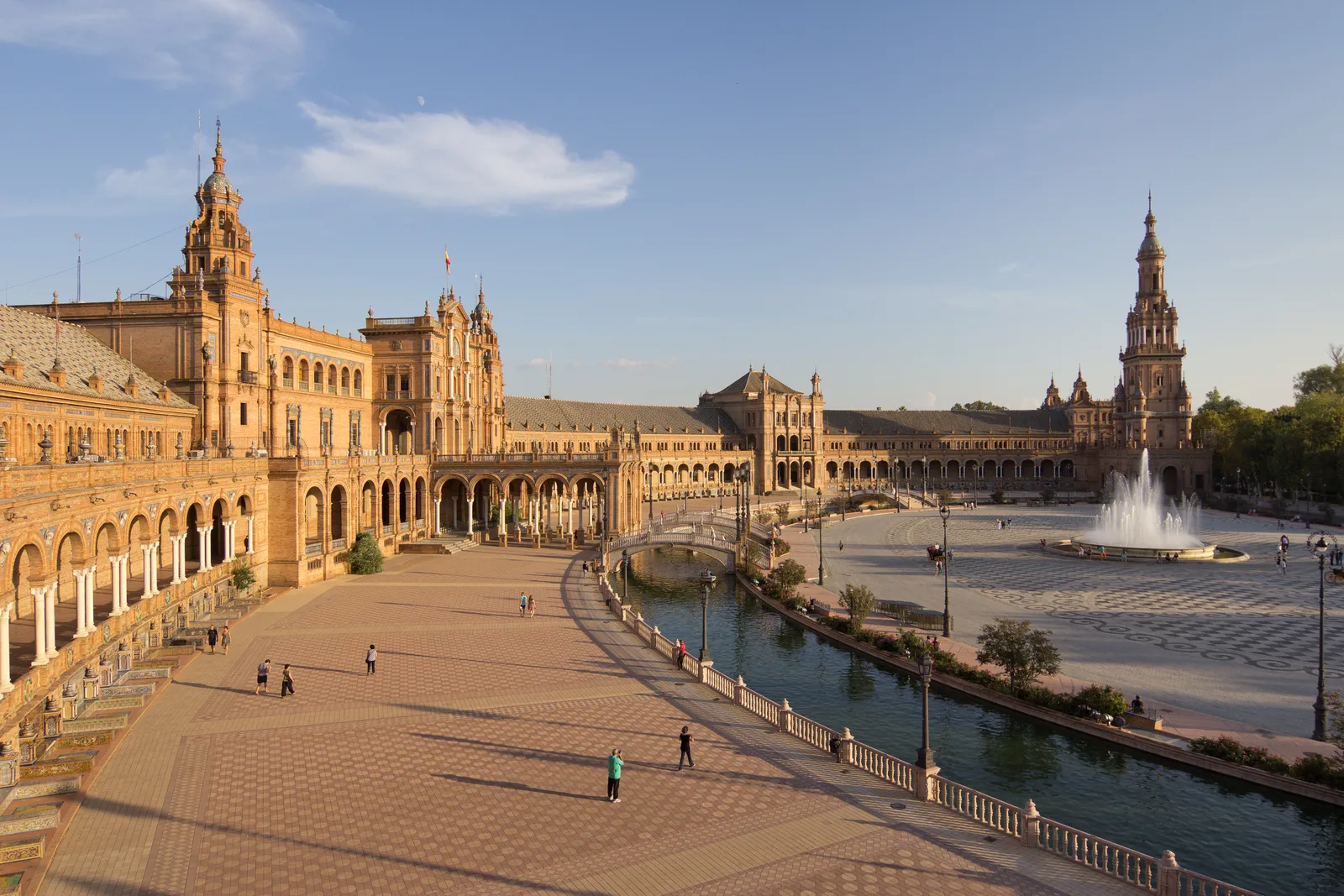
The 1929 exhibition's half-moon of brick, tile and bridges is free and open all day; at 8:30 a.m. you share it with joggers and the first horse carriages. Find your province's tiled bench, one for each of Spain's 48, before the tour buses arrive at 10.
The park behind the plaza has avenues of plane trees, tiled fountains and the Plaza de América with its two museums. The shade here is deep, which matters from June.
Walk north past the old tobacco factory (now the university) to the Alfonso XIII, built for the same 1929 exhibition; look at the facade from the street or buy a coffee for the tiles. Then the 13th-century Torre del Oro, where the small naval museum costs around €3 and closes mid-afternoon.
Across the Puente de Isabel II, the market sits on the foundations of the Inquisition's castle; stalls are open 9 a.m. to 2:30 p.m., Monday to Saturday. Two streets back on Calle Callao, the Centro Cerámica Triana (closed Monday) is the old Santa Ana tile factory with its kilns intact.
Calle Antillano Campos 26, a tiled corner bar: champiñones a la plancha, punta de solomillo, a caña. No reservations and full by 2:30 p.m.; La Antigua Abacería de San Lorenzo is the sit-down alternative.
Calle San Jacinto, the Capilla de los Marineros (free) and the ceramics shops on Calle Alfarería. Then go back to your room, as the city does; you have a late night ahead.
The timber canopy over the Plaza de la Encarnación has a walkway, a 360-degree deck and a night light show for around €15. Book the timed slot half an hour before sundown and stay for the lights; in summer sunset is after 9 p.m., so swap this with the flamenco show.
Calle Cuna 6, a five-minute walk: two one-hour shows a night, at 7:30 and 9 p.m., with four artists and no microphones in a courtyard of about a hundred seats, €18. Book on their own site a few days ahead; afterwards La Carbonería on Calle Céspedes is a free, unamplified flamenco bar.
Be at the door at 9 a.m.: the main patio, the azulejos and the garden are empty for the first half hour and the groups arrive at 10. Entry is €12 for the lower floor and patios, €18 with the guided visit upstairs.
Walk north through the Alfalfa and along Calle Feria (the Thursday flea market) to the long plaza with Roman columns at each end, the oldest public garden in Europe and now the bar district. Coffee and a tostada con tomate at any terrace; this is where the city has breakfast at eleven.
Ten minutes north by the old city wall: the Virgin of Hope on the altar, free to see when there is no mass (mornings until around 2 p.m., and again from 5). The treasury museum next door (around €5) shows the Semana Santa floats and the Virgin's mantles.
Calle Eslava 3, by the church of San Lorenzo, the bar that modernized Seville tapas: order the slow-cooked egg on boletus cake and the honey-glazed pork rib. No reservations at the bar, so arrive at 1:30 p.m. or wait; closed Monday, when Casa Ricardo on Calle Hernán Cortés stands in.
The Palacio de las Dueñas (Calle Dueñas 5, ten minutes east, around €15) is the Alba family's palace where Antonio Machado was born. Or take bus M-170 from Plaza de Armas to Itálica, the Roman city with a 25,000-seat amphitheater: 30 minutes, around €1.80, closed Monday and shut by 3 p.m. in summer.
Down to the Guadalquivir at the Torre del Oro and along the Paseo de Colón as the light goes, across the bridge once more. If you did Itálica, the M-170 drops you at Plaza de Armas, five minutes from the bridge.
The riverfront street with the Giralda across the water: Bar La Primera del Puente for fried fish and the view, then tapas at the counters toward the Puente de Triana. The terraces are for spring or fall; in winter eat inside at Casa Cuesta on Calle Castilla, a tiled 1880 bar.
Loading the map…
Pins are approximate. Tap one for the stop; the directions links open Google Maps.
The practical bits
From the airport
From Seville airport (SVQ), the TUSSAM EA bus runs every 20 to 30 minutes from early morning to past midnight to the Prado de San Sebastián and Plaza de Armas, calling at Santa Justa station, in about 35 minutes for €6 (€8 round trip, valid the next day), paid on board. An official taxi to the center is a fixed fare of around €25 to €30, a little more at night and during the Feria. There is no rail or metro link. From Madrid, the AVE reaches Santa Justa in 2 hours 30; from Málaga, the Avant in just under 2 hours.
What a day costs
About €70 to €110 a day per person. The Alcázar with the Cuarto Real Alto is €21 and the Cathedral €13; a tapas lunch at the counter is €12 to €18, a flamenco show €18 to €25, and the bus €1.40 a ride on the one day you need it.
Where to stay
Santa Cruz and the Arenal
The Alcázar, the Cathedral and the lanes, with the bullring and the river bars to the west. The most central and the most touristic; lovely at 8 a.m. and after 11 p.m.
Triana
Across the river: the market, the ceramics, Calle Betis and the flamenco peñas. Local in the daytime, loud at the water's edge at night, and the best view back at the city.
Alameda, Macarena and the Feria
The north of the old town: the long plaza of bars, the Thursday flea market, the Macarena basilica and the walls. Younger, cheaper, twenty minutes on foot from the Cathedral.
Got a day to spare?
Córdoba
The Mezquita, a forest of columns under a cathedral. 45 minutes by AVE or Avant from Santa Justa, from around €15 to €30 each way, book a week ahead. Entry is €15 (open 10 a.m. to 7 p.m. Monday to Saturday March to October, to 6 p.m. in winter, Sundays split around mass) with free individual entry 8:30 a.m. to 9:30 a.m. Monday to Saturday for the early train; the Jewish quarter and the Alcázar de los Reyes Cristianos fill the rest of the day.
Jerez de la Frontera
Sherry bodegas, the equestrian school and a Moorish alcázar. About an hour by train from Santa Justa, around €15 each way; book a bodega tour (Tío Pepe, Lustau, Tradición) for late morning and eat at Bar Juanito at 2 p.m. Thursday has the horse show.
Cádiz
The oldest city in western Europe on a spit in the Atlantic: the cathedral dome, the Torre Tavira's camera obscura, fried fish at the Mercado Central and La Caleta beach at sunset. About 1 hour 40 by train, around €17 to €25 each way; make a full day of it and take the late train back.
Worth knowing
Book the Alcázar's 9:30 a.m. slot and the Cathedral online before you fly; the Cathedral's roofs tour (€20, about 90 minutes) is a separate booking. If a Sunday lands on day 1, swap days, because the Cathedral opens only at 2:30 p.m. that day. Waystop's hours check flags a monument placed after its last entry.
From June to September walk between 8 a.m. and 1 p.m., sleep from 3 p.m. to 7 p.m., and eat at 10 p.m. with everyone else. Carry a bottle; the public fountains and the tap water are fine to drink.
Lunch is 2 p.m. to 4 p.m. and dinner from 9 p.m. At the counter, order two or three tapas a round, pay when you leave, and leave a euro or two in coins; nobody tips a percentage.
The Alcázar is open 9:30 a.m. to 7 p.m. April to September and to 5 p.m. October to March. It closes January 1 and 6, Good Friday and December 25.
Monday closes the Centro Cerámica, Itálica and the Macarena museum in the afternoon, and Casa Morales and Eslava on Sunday and Monday; the Alcázar, the Cathedral, the Casa de Pilatos and the Dueñas open every day.
Things you can ask once it’s in the app
Plans change. Ask Chat and it proposes a reshuffled day you can apply, or just answers the question.
Day 1 is a Sunday, move the Cathedral to the afternoon and fill the morningIt will be 106°F (41°C) on Tuesday, rebuild day 2 around the heatBook Córdoba for Wednesday and get us back for the 9 p.m. flamencoFind a vegetarian tapas crawl around the AlamedaAre the Alcázar and the Cathedral open during Semana Santa?
Questions
Which day works in the rain?
Day 1: the Alcázar's palaces, the Cathedral and the Archivo are all under cover and a few minutes apart. Waystop's rain plan can add a second version of the day that swaps the Santa Cruz walk for the Museo de Bellas Artes, free for EU citizens.
Do I need to book the Alcázar ahead?
Yes. Entry is timed and the morning slots sell out days ahead in spring and fall, weeks ahead in Semana Santa. The Cuarto Real Alto is a separate timed ticket for the same visit; the line at the Patio de Banderas desk is for leftovers.
Is Seville doable in August?
Doable, not pleasant: 104°F (40°C) most afternoons and some bars shut for the month. Keep the plan but move everything to before 1 p.m. and after 8 p.m., and pick a room with a pool or a rooftop.
Is three days enough for Seville?
Yes, for the monuments, two neighborhoods and a flamenco night. A fourth day adds Córdoba's Mezquita by train or Cádiz and the Atlantic; a fifth, Jerez and a sherry bodega.
Add your dates, your hotel and who’s coming, then ask Chat to change anything: it proposes the edit and you tap Apply. Want a long lunch instead of a museum? Just ask. Every place is checked against Google Maps before it lands on your day, and Chat can tell you when to leave for the next stop. Going on to another city? Build a multi-city trip.