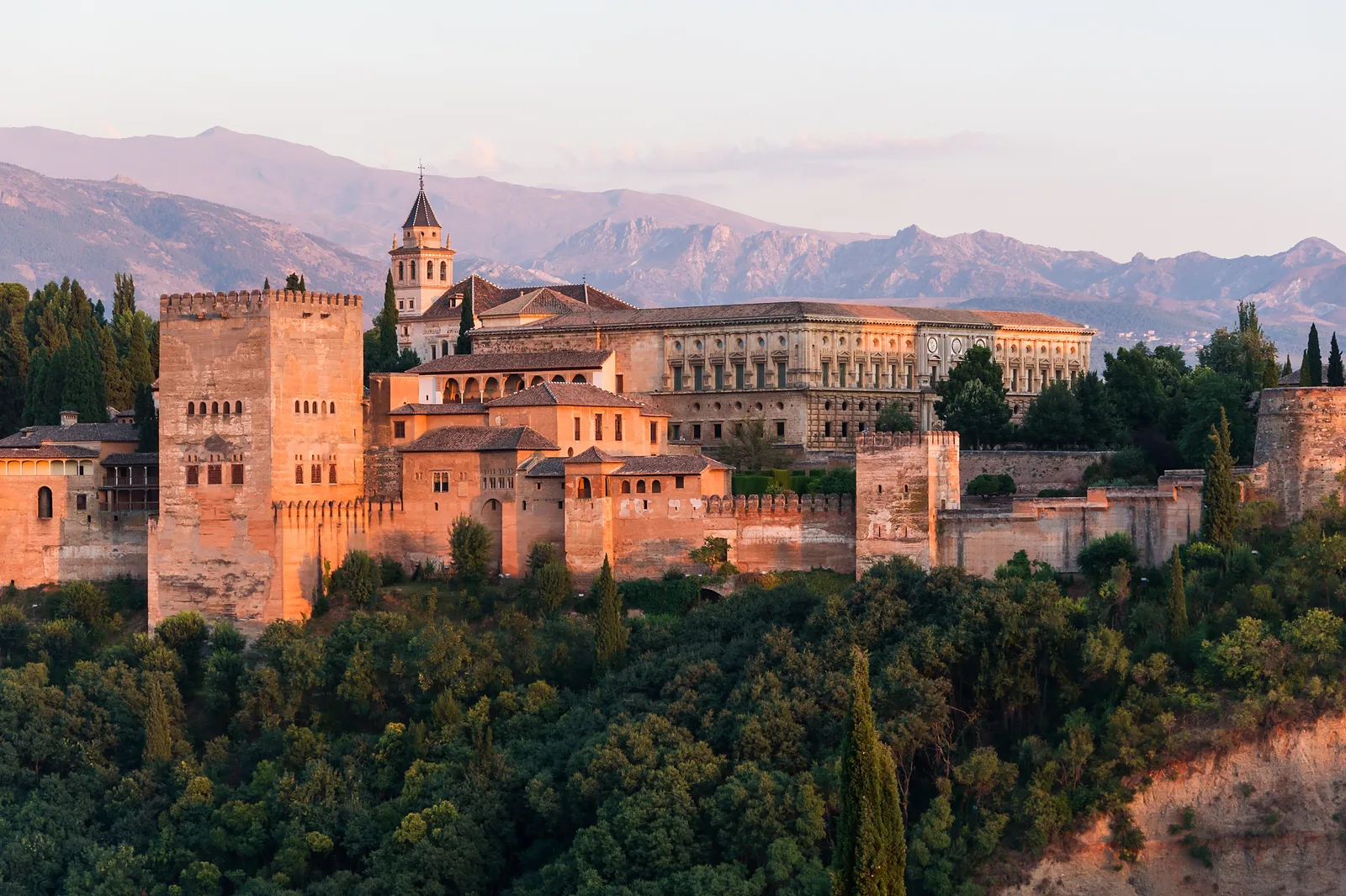
Three days built around the one ticket that matters: the Alhambra on day one with the Nasrid Palaces slot booked weeks ahead, then the Cathedral, the Albaicín and a cave flamenco show, then a hammam, the Realejo and a last round of free tapas.
April to early June and late September to October are the good weeks: warm days, cool nights, the Generalife in flower or the poplars turning. July and August pass 95°F (35°C) most afternoons and the Alhambra is a furnace by noon. Winter is cold and bright, the Sierra Nevada is white behind the palace, and Alhambra tickets are easy. Holy Week and the Corpus fair in June fill every room.
Where to base yourself
Sleep in the Realejo or around Plaza Nueva for the Alhambra on foot and the tapas streets at your door. The lower Albaicín (Carrera del Darro, Paseo de los Tristes) is the prettiest address and the steepest; the upper Albaicín means cobbles and a taxi that cannot reach the door. The Gran Vía and Puerta Real blocks are flat, central and plainer.
Getting around
Walk; the center is small and the hills are steep. The red minibuses do the climbs: C30 runs from Plaza Isabel la Católica to the Alhambra about every 12 minutes, C32 links the Alhambra and the Albaicín, C31 climbs the Albaicín and C34 reaches Sacromonte. A single ride is €1.60 paid to the driver; a Credibús card (€2, then about €0.54 a ride) pays off from your fourth ride and is sold on board. Taxis are metered and cheap for the one evening in Sacromonte. Check the Rober operator's notices: the C30 and C31 routes were rerouted in summer 2026 during roadworks on Reyes Católicos.
Enter at the Pabellón de Acceso with the Alhambra General ticket (€22.27), booked only on tickets.alhambra-patronato.es, and start at the Generalife so the Nasrid slot is still ahead of you. Bring the passport or ID you booked with, because the gate scans it.
Walk the length of the hill, past the Palace of Charles V, to the fortress at the tip, with the Torre de la Vela over the whole city. Forty minutes is enough; be at the Nasrid Palaces line ten minutes before your slot.
The reason you came: the Mexuar, the Court of the Myrtles, the Hall of the Ambassadors and the Court of the Lions, then the Partal gardens on the way out. Go slowly, since there is no re-entry, and note that the 30-minute entry window on your ticket is strict.
Leave by the Puerta de la Justicia and drop through the Realejo in 15 minutes to Placeta del Agua 3, a small wine bar with a long Spanish list by the glass and a free tapa with each one. If it is full, the terraces on the Campo del Príncipe two minutes away do the same.
After a rest, climb from Plaza Nueva up Calderería Nueva (the tea houses and spice shops), then Cuesta de San Gregorio to Plaza Larga, the Albaicín's own square. Allow 40 minutes with wrong turns, or ride the C31 from Plaza Nueva if your legs have had enough hill.
The view of the Alhambra against the Sierra Nevada that most photos of Granada are taken from. Arrive an hour before sunset for a spot on the wall; sunset is about 7:40 p.m. in early October and 9:30 p.m. in June, so shift this stop with the season.
Down the hill to the tapas street behind the town hall. Los Diamantes at Calle Navas 28 fries fish and does it standing: a drink is about €2.50 to €3.50 and comes with a tapa you do not choose, so three drinks is dinner.
Calle Oficios, beside the Cathedral: Isabella and Ferdinand lie here under Fancelli's marble, and the sacristy museum holds her crown, his sword and Flemish paintings. €7 with the audio guide; open from 10 a.m. and shut for lunch at 2 p.m..
Enter from Gran Vía. The Renaissance nave built by Siloé is white, high and bright, which surprises people expecting Seville's gloom; €10 with a digital audio guide, so bring earphones.
The lanes south of the Cathedral were the Moorish silk market and, rebuilt after an 1840s fire, are now stalls of lamps, inlaid boxes and scarves. Then cross to the Madraza, the 1349 Nasrid university, whose oratory has a stucco mihrab and a painted wooden dome; go before 2 p.m..
Carrera del Darro 31: an 11th-century hammam lit by star-shaped holes in the vaults, on the Andalusian Monuments ticket (€7.42) and free on Sunday. In summer it closes from 2:30 to 5 p.m., so keep this slot before lunch.
The lane along the river under the Alhambra's north walls, with the stone bridges, the Casa de Castril and the convent of Santa Catalina de Zafra. It is fifteen minutes end to end if you do not stop, and it opens out at the Paseo de los Tristes with the palace straight above you.
Paseo del Padre Manjón 1, at the far end of the Paseo de los Tristes with the Alhambra in the window: a lamb tagine, couscous or salmorejo. Book a window table a day ahead at weekends; the bars on the paseo do a long tapas lunch on the terraces.
Follow the Camino del Sacromonte for 25 minutes, or ride the C34 to the Barranco de los Negros stop. Eleven whitewashed caves set up as they were lived in, with a view of the Alhambra and the Generalife from the terraces; €5, open daily from 10 a.m. and out before the light goes.
Back down to Calle Almireceros 1, off Calle Elvira: a 1927 bodega with barrels on the wall, vermouth on tap and a free tapa with every glass. Eat enough here that the show's one drink is a drink and not dinner.
Take a taxi (about ten minutes) or the C34 up to Cuevas Los Tarantos, where the zambra, Granada's own flamenco, is danced in a whitewashed cave a meter from your knees. About €30 with one drink for a 75-minute show; book online a day or two ahead in summer.
€30
Day 3
A hammam, the Realejo and the gardens, or the Sierra
Calle Santa Ana 16, behind the church at the foot of the Alhambra hill: three pools at 97°F (36°C), 104°F (40°C) and 64°F (18°C) and a eucalyptus steam room in a tiled, candle-lit vault. Sessions run 90 minutes and the bath alone is €52; book several days ahead, bring a swimsuit and go in the morning.
Walk up through the old Jewish quarter looking for the murals by El Niño de las Pinturas, who paints faces and verses on whole house ends around Calle Molinos and the Plaza de Fortuny. Forty minutes of lanes, with the Campo del Príncipe and the Alhambra Palace hotel above you.
Calle Santa Escolástica 9, at the top of the Realejo: a loud neighborhood bar where the free tapa with each drink is generous, often a montadito or a plate of stew. Stand at the bar and order a second round, and lunch is under €10.
Fifteen minutes uphill past the Alhambra Palace hotel: a 19th-century garden with a lake, a palm walk and peacocks, and views south over the Vega. Free, and closed for a long lunch on weekdays, reopening about 4 p.m..
Bar Poë, Calle Verónica de la Magdalena 40, ten minutes west of Puerta Real, is run by a British-Angolan couple whose free tapas are feijoada, Thai chicken and piri-piri stew with each €3 drink. Then back to Calle Elvira for the bars until well after midnight.
Loading the map…
Pins are approximate. Tap one for the stop; the directions links open Google Maps.
The practical bits
From the airport
From Granada airport (GRX), the Alsa bus (line 245) meets arriving flights and runs into the city in about 45 minutes for €3.10, paid on board, stopping on Gran Vía by the Cathedral and at the bus station; a taxi is around €30. From Madrid, Renfe's AVE and the Iryo and Ouigo trains reach Granada station in about 3 hours 20, from around €20 booked early to €80 and more on the day; the station is a 15-minute walk or a short bus ride north-west of the center. From Málaga, Alsa coaches take about 1 hour 45 to the bus station on the ring road; from Seville, about 3 hours.
What a day costs
About €70 to €110 a day per person. The Alhambra is €22.27, the Royal Chapel €7, the Cathedral €10 and the Bañuelo €7.42; the hammam is €52 and the flamenco show about €30 with a drink; a tapas lunch or dinner is three drinks at about €3 each, a sit-down lunch €20 to €30, and the bus €1.60 a ride on the two or three rides you take.
Where to stay
Albaicín
The Moorish hill facing the Alhambra: whitewashed lanes, carmen gardens behind high walls, the miradores. Beautiful, steep, and a taxi stops at the bottom; the lower Darro streets are the practical compromise.
Realejo
The old Jewish quarter under the Alhambra's south walls, now the neighborhood of murals, wine bars and the Campo del Príncipe terraces. Flat enough at the bottom, close to everything, and local at night.
Centre and Plaza Nueva
The Cathedral, the tapas streets of Navas and Elvira, the Alhambra and Albaicín buses all start here. Loud until late, but every day of this trip begins or ends within five minutes of it.
Got a day to spare?
Sierra Nevada
Europe's southernmost ski resort, 32 kilometers from the city. The Tocina bus runs from the bus station to Pradollano in about an hour for €5 each way, frequently in ski season from December to April; in summer it is a hiking base for the Veleta road.
The Alpujarra
Pampaneira, Bubión and Capileira, three white villages stacked up the Poqueira gorge on the south side of the Sierra. Two hours by Alsa bus or an hour and a half by rental car; go for the walk between them and a plato alpujarreño lunch.
Córdoba
The Mezquita and the patios. The train to Córdoba takes about 1 hour 30 on the fast line and the Mezquita is a 20-minute walk from the station; book the first train and the Mezquita's 8:30 a.m. free entry hour on weekdays.
Worth knowing
Book the Alhambra first and plan everything else around the Nasrid Palaces slot. Sales open about a year ahead; in high season the General ticket is gone one to two months out, and if it sells out the official guided tours, the Dobla de Oro ticket (about €30) or the night visit (about €13, limited nights) are the ways in. Buy only on tickets.alhambra-patronato.es, because resellers charge €40 and up.
Carry the passport or identity card you booked the Alhambra with. Tickets are in your name and the gate scans the document; a photo on your phone is refused.
A drink in Granada comes with a free tapa and that is dinner for most locals. Order one drink at a time, move after two, and expect bars to be empty before 9 p.m. and full at 10:30 p.m..
The city is built on three hills. Do the Alhambra and the Albaicín on separate days, put the climbs in the morning or at sunset, and let the C30, C31 and C32 minibuses do the steep bits for €1.60.
Most monuments outside the Alhambra close for lunch, often from 2 to 4 or 5 p.m.. Churches, the Madraza and the Bañuelo in summer are morning stops; gardens and the Science Park fill the afternoon.
Opening times to plan around: the Royal Chapel and the Cathedral run Monday to Saturday (the Cathedral on Sunday only after Mass), the Madraza has short hours, and Carmen de los Mártires closes at lunch on weekdays. The Hammam Al Ándalus sessions start every two hours from 10 a.m., and in ski season the Tocina bus to the Sierra Nevada (€5 each way) is the swap for the morning.
Things you can ask once it’s in the app
Plans change. Ask Chat and it proposes a reshuffled day you can apply, or just answers the question.
The Alhambra General ticket is sold out for our dates, what are our options?Our Nasrid Palaces slot is 3:30 p.m., can day 1 be reordered around it?Which tapas bars on day 3 can feed a vegetarian?How do we get from the Alhambra exit to the Mirador de San Nicolás by bus?What should we pack for Granada in January if we add a Sierra Nevada morning?
Questions
How far ahead do I need to book the Alhambra?
Tickets go on sale about a year ahead on the Patronato's own site. For spring, fall and Holy Week book six to eight weeks out; in January and February a week is usually enough. The General ticket (€22.27) with a Nasrid Palaces slot is the one to get; if it is gone, the official guided tours, the Dobla de Oro or the night visit (check the nights on the Patronato's site) still get you into the palaces.
Is three days enough for Granada?
Yes, at this pace: one day for the Alhambra and the Albaicín, one for the Christian center and Sacromonte, one for a slow Realejo. A fourth day buys the Sierra Nevada or the Alpujarra villages; a fifth, Córdoba by train and back.
Which day works in the rain?
Day 2: the Royal Chapel, the Cathedral and the Madraza are indoors, lunch is a sit-down, and the cave show is dry by definition. On day 3 the hammam does not care about the weather and the Parque de las Ciencias replaces the garden; a rain plan in Waystop's Chat gives you that version of the day.
Is the free tapa really free?
Yes. Every drink at a traditional bar in Granada comes with a small plate you do not choose, and the drink costs about €2.50 to €3.50. Bars that hand you a menu first are aimed at visitors; the ones with a crowd standing at the counter are not.
Add your dates, your hotel and who’s coming, then ask Chat to change anything: it proposes the edit and you tap Apply. Want a long lunch instead of a museum? Just ask. Every place is checked against Google Maps before it lands on your day, and Chat can tell you when to leave for the next stop. Going on to another city? Build a multi-city trip.