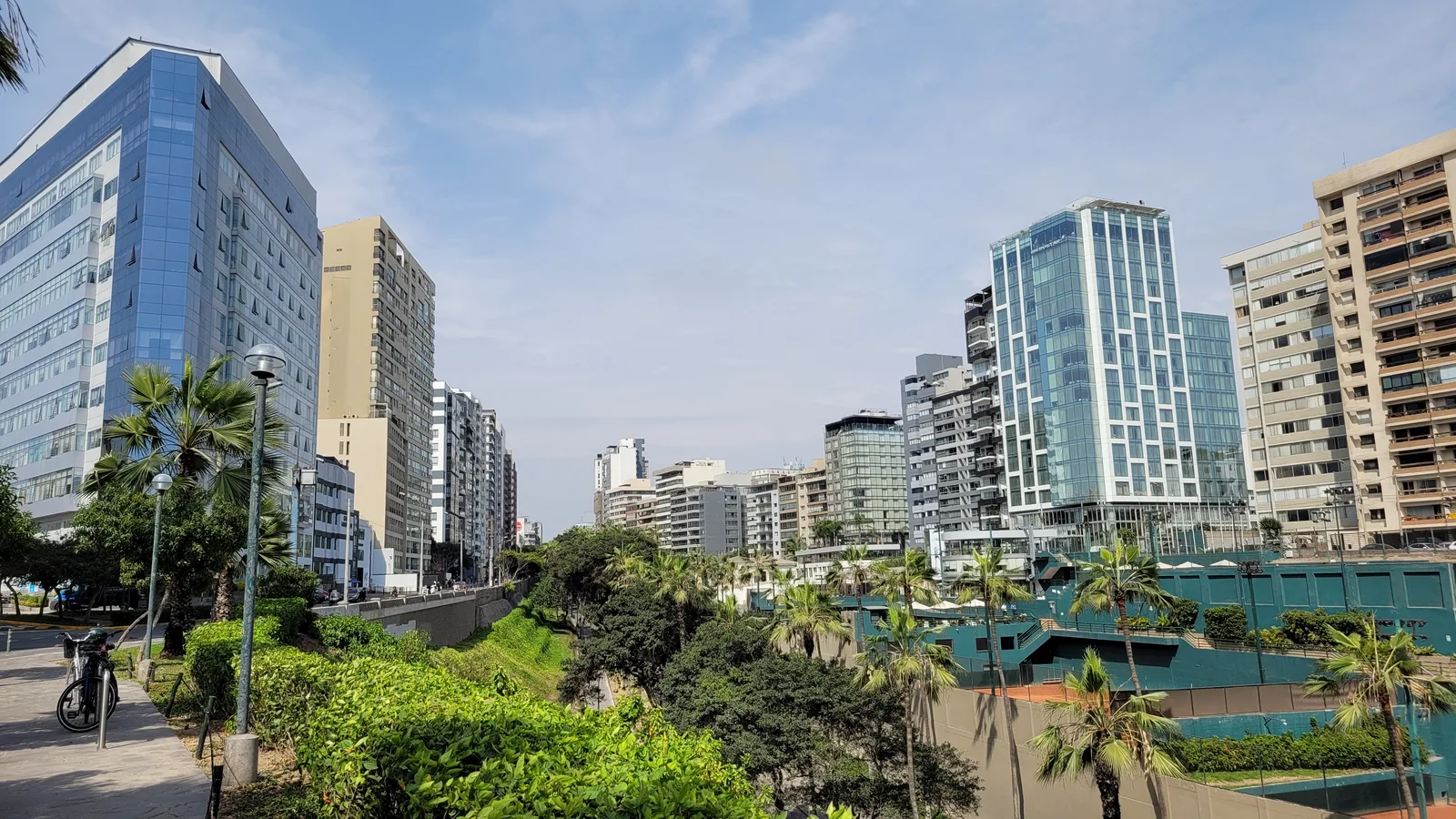
Two days in Lima for the clifftop walk, a ceviche lunch and the Larco Museum, then three at altitude: a gentle first day in Cusco, Machu Picchu by train with a timed circuit ticket, and the Sacred Valley's terraces and salt pans.
May to September is Cusco's dry season: clear days, cold nights near freezing in June and July, and the busiest months at Machu Picchu. November to March is the wet season, heaviest in January and February, when the Inca Trail closes but Machu Picchu stays open and the trains from Cusco itself run as a bus plus train service. Lima is the other way round: gray, damp and 59 to 66°F (15 to 19°C) from May to November under the garúa mist, sunny and 77 to 86°F (25 to 30°C) from December to April. April and October give you the best of both, and layers plus a rain shell cover any month.
Where to base yourself
In Lima, Miraflores for the clifftop parks, the restaurants and the safest streets at night, or Barranco for the bars and the murals a short ride south; the historic center is for the daytime only. In Cusco, San Blas for the lanes and the views, or around the Plaza de Armas for flat walking; both are steep, so check the climb to your door. A night in Ollantaytambo before Machu Picchu saves an hour's drive at dawn and sleeps 600 meters lower than Cusco.
Getting around
Lima taxis have no meters: agree the fare before you get in, or use Uber, Cabify, DiDi or inDrive, which is what locals do and the only sensible option after dark. The Metropolitano bus runs Miraflores to the center in about 30 minutes for around S/3 on a rechargeable card. Cusco's center is walked; a taxi across town is S/6 to S/10 and the airport is 15 minutes away. For the Sacred Valley, colectivo minivans leave from Calle Puputi (for Pisac) and Pavitos (for Urubamba and Ollantaytambo) for S/5 to S/15, or book a driver for the day for S/250 to S/350; with colectivos, choose the Pisac side or the Maras side of the valley in a day, not both. For the train, a pre-booked taxi from Cusco to Ollantaytambo station is S/100 to S/150 and takes 1 hour 45 minutes.
Day 1
Lima: the Malecón, ceviche, a pyramid and Barranco at dusk
Six kilometers of clifftop park above the Pacific, from Parque Kennedy out to the sea, then south through Parque del Amor past the paragliders to Larcomar, the mall built into the cliff. In the gray months the fog burns off by 11 a.m., if at all.
Gastón Acurio's cevichería on Avenida La Mar, open for lunch only because the fish is bought that morning. Arrive by 12:30 p.m. for a table without a long wait and share the ceviche clásico, a tiradito and the chicharrón de pescado.
A pre-Inca adobe pyramid among the apartment blocks, ten minutes' walk from La Mar, seen on a guided tour of about 45 minutes (English tours run through the day). Open Wednesday to Monday 9 a.m. to 5 p.m., closed Tuesday.
Back to the hotel for an hour, then a taxi or Uber to Barranco's plaza, 15 minutes and about S/12 to S/15. Aim to be on the bridge for the last light, around 6 p.m. in the gray months and nearer 6:45 p.m. in summer.
The wooden Bridge of Sighs over the ravine, then the Bajada down to the sea past the murals as the sun drops; locals hold their breath across the bridge for a wish. Have a pisco sour at Juanito's on the plaza, a bar that has not changed since the 1930s, or a beer at Barranco Beer Company.
Old Lima criollo cooking in huge portions on Avenida San Martín: lomo saltado, cau cau, tacu tacu with a fried egg. Order fewer plates than you think, and book a few days ahead for a weekend or walk in before 7:30 p.m.
Day 2
Lima's center, a chifa lunch, the Larco Museum and the flight south
Thirty minutes by taxi or the Metropolitano from Miraflores, to the Government Palace, the Archbishop's Palace with its carved cedar balconies and the cathedral around the square. Keep bags in front of you here and in the lanes around the market.
Pizarro's tomb is in the first chapel on the right, and the choir stalls and the museum of religious art are the rest. Around S/20 covers the cathedral and the Archbishop's Palace; it closes early on Sunday for mass, so go Monday to Saturday if you can.
Two blocks east, the convent visit is guided only, about 45 minutes in Spanish or English, and ends in the catacombs where some 25,000 skeletons are sorted into pits by bone. Around S/20, open daily from 9 a.m. with the last tours about 5:30 p.m.; the church itself is free.
Ten minutes' walk to Calle Capón, Lima's Chinatown, for Peru's Cantonese cooking: San Joy Lao (in business since 1927) or Wa Lok a block away for arroz chaufa, wantán frito and chi jau kay. The Mercado Central next door is the cheap alternative, with a S/12 menú at the counters upstairs.
Twenty minutes by taxi to Pueblo Libre, where four thousand years of ceramics, gold and textiles fill a colonial house under bougainvillea, with open storerooms and the erotic gallery in its own building. Open daily 9 a.m. to 7 p.m. (6 p.m. on December 24 to 26 and January 1), S/50 and a little less online; allow two hours.
Cusco's airport takes no night landings, so the last flights from Lima leave in the late afternoon; from Pueblo Libre the new terminal is 30 to 45 minutes by Uber (S/40 to S/70). If you would rather not rush, stay the night and take the first flight tomorrow, around 5 a.m., since day 3 is deliberately slow.
In Cusco, keep it light on the first night at altitude: a soup and a coca tea at Morena or Jack's Café near the plaza, no alcohol, early bed. If you stayed in Lima, this is the night for Central or Maido with a booking made months ago, or Astrid y Gastón in Casa Moreyra without one.
Cusco sits at 3,400 meters, so walk slowly, drink water and keep today flat. The cathedral (around S/40, or on the religious circuit ticket) holds Marcos Zapata's Last Supper with a guinea pig on the table, and the Compañía de Jesús across the square has the better façade.
Five minutes downhill along Loreto, past the finest Inca wall in the city, to the Temple of the Sun, once sheathed in gold, with the Dominican church built on top. S/15 at the door, not on the Boleto Turístico; open Monday to Saturday 8:30 a.m. to 5:30 p.m., Sunday afternoons only.
Ten minutes' walk west, with fruit you have never seen, cheeses, bread from Oropesa and a row of comedores at the back serving a two-course menú for S/8 to S/12; a caldo de gallina is what altitude wants. Watch your pockets at the entrances.
Take an hour at the hotel first, since the rule is nothing strenuous in your first 48 hours at altitude. Then climb Cuesta San Blas slowly to the artisans' quarter, with its carved-pulpit church (on the religious circuit ticket), the Mendívil and Mérida family workshops, and coffee with a view at Qura or L'Atelier.
The Boleto Turístico General costs S/130 for foreigners and is valid ten days across 16 sites; you need both circuits on this trip, so buy it rather than the S/70 partials. Then take a S/15 taxi up to Sacsayhuamán, because the walk from San Blas is a 30-minute climb you should not do today.
The fortress of zigzag walls above the city, with stones the size of vans fitted without mortar; open daily until about 6 p.m. and nearly empty in the last hour. Walk the three terraces and watch the lights come on across Cusco, then take a taxi back down, as it gets dark and cold fast.
A courtyard restaurant on Plazoleta San Blas with a wood oven, serving trout, alpaca, quinoa soup and cuy (guinea pig) if you order it a day ahead. Eat early and light, skip the pisco, and be in bed by 9:30 p.m., since tomorrow starts before dawn.
PeruRail and Inca Rail both run the line, so book the earliest train you can six to eight weeks ahead in high season. From Cusco, a pre-booked taxi to Ollantaytambo station takes about 1 hour 45 minutes, or sleep in Ollantaytambo the night before.
Sit on the left out of Ollantaytambo for the river, as the valley narrows and the eucalyptus gives way to cloud forest. The train arrives at Machu Picchu Pueblo (Aguas Calientes), where you should buy the return bus ticket straight away if you did not get it the day before.
The only motor transport up the 8 km switchback road is the Consettur bus (US$12 each way, 25 minutes) from the ticket office on Avenida Hermanos Ayar, with buses leaving from 5:30 a.m. as they fill. Be at the gate 30 minutes before your slot; the walk up is 90 minutes of stone steps.
Indio Feliz on Calle Lloque Yupanqui is the village's long-running French-Peruvian table, with a three-course set menu around S/80; book or arrive at opening. Mapacho on the river does trout, a good lomo saltado and Cusco craft beer.
The craft market fills the hall between the station and the bridge, with alpaca or acrylic sold as alpaca, so buy what you like at a price you like. Sit by the Urubamba with a coffee until the train, and be at the station 30 minutes early with your passport; you reach it through the market.
Afternoon and evening trains run until about 9:30 p.m. Ollantaytambo by 6:30 p.m. leaves an evening in the village's Inca streets, while the through service to Poroy or the bus plus train to Cusco gets you back around 9 to 10 p.m.
If you stopped in Ollantaytambo, El Albergue's restaurant is in the station itself, with vegetables from its own farm, and Chuncho on the plaza does Andean dishes. If you rode through to Cusco, Chicha por Gastón Acurio on Plaza Regocijo serves until late.
S/90
Day 5
The Sacred Valley: Chinchero, Moray, the salt pans and Pisac
Forty minutes from Cusco, or an hour from Ollantaytambo, on the high plain at 3,760 meters, where a colonial church sits on Inca walls above terraces and the weaving cooperatives show dyeing with cochineal and plants. The Sunday market is the real one, with barter still going on in the produce rows.
Thirty minutes on by road, concentric terraces sunk into a bowl, each ring a few degrees warmer than the one above; the best guess is an Inca agricultural laboratory. Walk the rim rather than down into it if you are still feeling the altitude.
Fifteen minutes down a dirt road, three thousand salt pans fed by a warm spring and worked by the families of Maras since before the Incas. Not on the Boleto Turístico: around S/20 in cash at the gate, and since 2019 you walk the paths above the pans, which is still the view.
Thirty minutes down to the valley floor, a garden restaurant on Calle Arica serving alpaca with quinoa, trout and the huacatay (black mint) sauce it is named for. Tres Keros on the main road is the alternative, and Urubamba at 2,870 meters is where your appetite comes back.
Forty minutes east along the river; have the driver take you to the top gate so you walk down through the citadel past the Intihuatana sun temple and the terraces. Allow an hour and a half descending to the village on foot, or 45 minutes at the top and the car back down.
The craft market around the plaza now runs every day, biggest on Sunday, Tuesday and Thursday: textiles, silver, painted gourds, and clay ovens baking empanadas by the church. Haggle gently; it is an hour back to Cusco by taxi or the Calle Puputi colectivo (S/5).
Cicciolina upstairs on Calle Triunfo has a tapas bar and Andean-Mediterranean plates, and Chicha por Gastón Acurio on Plaza Regocijo gives the chef's take on Cusco's cooking, with chairo soup and adobo. Book either a few days ahead; a pisco sour is fine now that you have had your two days.
S/120
Loading the map…
Pins are approximate. Tap one for the stop; the directions links open Google Maps.
The practical bits
From the airport
Lima's new Jorge Chávez terminal opened on June 1, 2025, reached only from Avenida Morales Duárez over new bridges across the Rímac, so expect a longer curb-to-car walk than the old building. To Miraflores or Barranco: the Airport Express Lima coach from the terminal for S/15 one way, every 30 minutes or so, 45 to 75 minutes depending on traffic; the authorized taxi counters in arrivals (Taxi Green, Taxi 365 and others) for around S/60 to S/80; or an Uber, Cabify or DiDi from the signed pickup in Parking E1 for S/40 to S/70 off peak. Ignore anyone offering a taxi inside the hall. Lima to Cusco is about an hour and twenty minutes with LATAM, Sky or JetSMART; Cusco's airport works in daylight hours only, and a taxi to the center is 15 minutes and S/20 to S/30.
What a day costs
About S/150 to S/250 a day per person in Lima and Cusco for meals, museums and taxis; a proper ceviche lunch is S/80 to S/100 (La Mar, or El Mercado and Punto Azul nearby) and a market menú S/12. Huaca Pucllana is S/15 by day and S/17 on its night tours, Wednesday to Sunday. The Machu Picchu day is the big one, at S/750 to S/1,100: the S/152 entry (plus a card fee of about 5 percent), two train legs at US$65 to US$130 each, the US$24 round-trip bus and lunch. Trains run from about US$65 one way (PeruRail Expedition) and US$95 (Vistadome), or US$60 (Inca Rail Voyager) and US$100 (The 360), with prices moving by date and hour; a guide at the gate is optional, around US$60 for a small group. The Boleto Turístico adds S/130 and a day's driver in the Sacred Valley S/250 to S/350, shared between the car.
Where to stay
Miraflores, Lima
The clifftop parks, the cevicherías and most of the hotels. Safe to walk at night, well served by Uber, and the start of the Metropolitano into the center.
Barranco, Lima
The bohemian district south of Miraflores: the bridge, the murals, the bars on the plaza and the old houses turned galleries. Quieter to sleep in, 15 minutes from everything by taxi.
San Blas, Cusco
The artisans' hill above the plaza: steep whitewashed lanes, workshops, cafés with views and the best small hotels. Steep also means every walk home is a climb at 3,500 meters.
Got a day to spare?
Rainbow Mountain (Vinicunca)
The striped mountain at 5,200 meters, three hours' drive from Cusco and a 90-minute climb from the parking lot; tours leave at 4 a.m. and cost S/100 to S/150 with breakfast. Only after three or four days at altitude, and never as your first day. Palccoyo is the easier alternative at 4,900 meters with less walking.
Humantay Lake
A turquoise glacial lake at 4,200 meters below the Salkantay peak, three hours west of Cusco and a steep hour on foot from the trailhead at Soraypampa. Day tours run around S/100; horses are available at the bottom for those who struggle.
The Nazca lines, from Lima
Seven hours south by bus on the Panamericana, then a 35-minute overflight from Nazca's airstrip for around US$100 plus airport tax. Too far for a day; do it as an overnight, or fly from Pisco near Paracas, which is three and a half hours from Lima and pairs with the Ballestas islands.
Worth knowing
Altitude is the thing that spoils this trip. Cusco is 3,400 meters; take the first two days slowly, drink more water than you want, eat light, skip alcohol, and drink the mate de coca every hotel offers. Acetazolamide works if you start it a day before you fly up, but ask a doctor first. If you feel bad, go lower: the Sacred Valley sleeps 600 meters down, and Machu Picchu itself is at 2,430 meters and easier than Cusco.
Buy the Machu Picchu entry ticket first, then the trains, then the flights, and only on the official site, tuboleto.cultura.pe. The ticket is nominal, so carry the passport you booked with.
The Boleto Turístico General at S/130 covers Sacsayhuamán, Pisac, Chinchero, Moray and a dozen more for ten days; the two S/70 partial tickets (Circuit I and Circuit III) cost more and cover less. Buy it at the COSITUC office on Avenida El Sol 103 or at the sites, in cash where possible. Qorikancha, the cathedral, Maras and Machu Picchu are all separate, the covered sites open about 7 a.m. to 5 p.m., and the Sacred Valley has few ATMs, so carry soles.
Do not drink the tap water anywhere in Peru; bottled or filtered only, and hotels in Cusco usually have a filter jug. Tip 10 percent in restaurants when no service charge is added (the bill may say servicio), a few soles for a porter and S/20 to S/50 for a guide or a driver at the end of the day. Taxis are not tipped.
Since 2024 Machu Picchu has three circuits with hourly entry slots from 6 a.m. Circuit 1 is the view without the city; Circuit 3 is the city without the view, with Huayna Picchu on route 3-A for S/200 and 200 places a day. Routes 1-C (Sun Gate) and 1-D (Inca Bridge) run only from June 1 to October 15.
Things you can ask once it’s in the app
Plans change. Ask Chat and it proposes a reshuffled day you can apply, or just answers the question.
Our Machu Picchu slot is 10 a.m., which train from Ollantaytambo gets us there in time?Could we sleep in the Sacred Valley first and do Cusco last, and what would change?It is raining on day 5, what do we do in Cusco instead?Where do we eat ceviche in Barranco at lunchtime?Where could a Rainbow Mountain day fit without breaking the two-day altitude rule?
Questions
Should I do the Sacred Valley before Cusco for the altitude?
It helps. Fly to Cusco, go straight down to Ollantaytambo or Urubamba (2,800 to 2,900 meters) for days 3 and 4, do Machu Picchu from there, and finish with Cusco on day 5. Ask Waystop's Chat to reorder the days and it proposes the new order as a card; check the train and ticket dates still line up.
Which day works in the rain?
Day 2 in Lima: the cathedral, the catacombs and the Larco Museum are all under roofs, and Lima barely rains anyway. In Cusco, the Inka Museum and the Pre-Columbian Art Museum fill a wet afternoon, and Machu Picchu is open rain or shine. Ask Waystop for a rain plan for day 2 or day 5 and its Chat adds a second version of that day, leaving your main plan as it is.
Can I do Machu Picchu as a day trip from Cusco?
Yes, and most people do: a 4:30 a.m. start, the train from Ollantaytambo or Poroy, three hours on the site, and back by 9 p.m. or later. From Poroy the train takes about 3 hours 30 minutes and runs in the dry season only (from January to April both operators run a bus to Ollantaytambo and the train from there), and luggage is limited to an 8 kg daypack. A night in Ollantaytambo or Aguas Calientes before or after makes it a kind day.
How far ahead do I need to book?
Machu Picchu entry three to four months out for May to September, six to eight weeks otherwise; Circuit 2 and the mountains sell out two to four months ahead in the dry season. Trains six to eight weeks, the Consettur bus the day before in Aguas Calientes, and the Boleto Turístico on the day. Flights Lima to Cusco run every hour and are cheapest a month out.
Add your dates, your hotel and who’s coming, then ask Chat to change anything: it proposes the edit and you tap Apply. Want a long lunch instead of a museum? Just ask. Every place is checked against Google Maps before it lands on your day, and Chat can tell you when to leave for the next stop. Going on to another city? Build a multi-city trip.