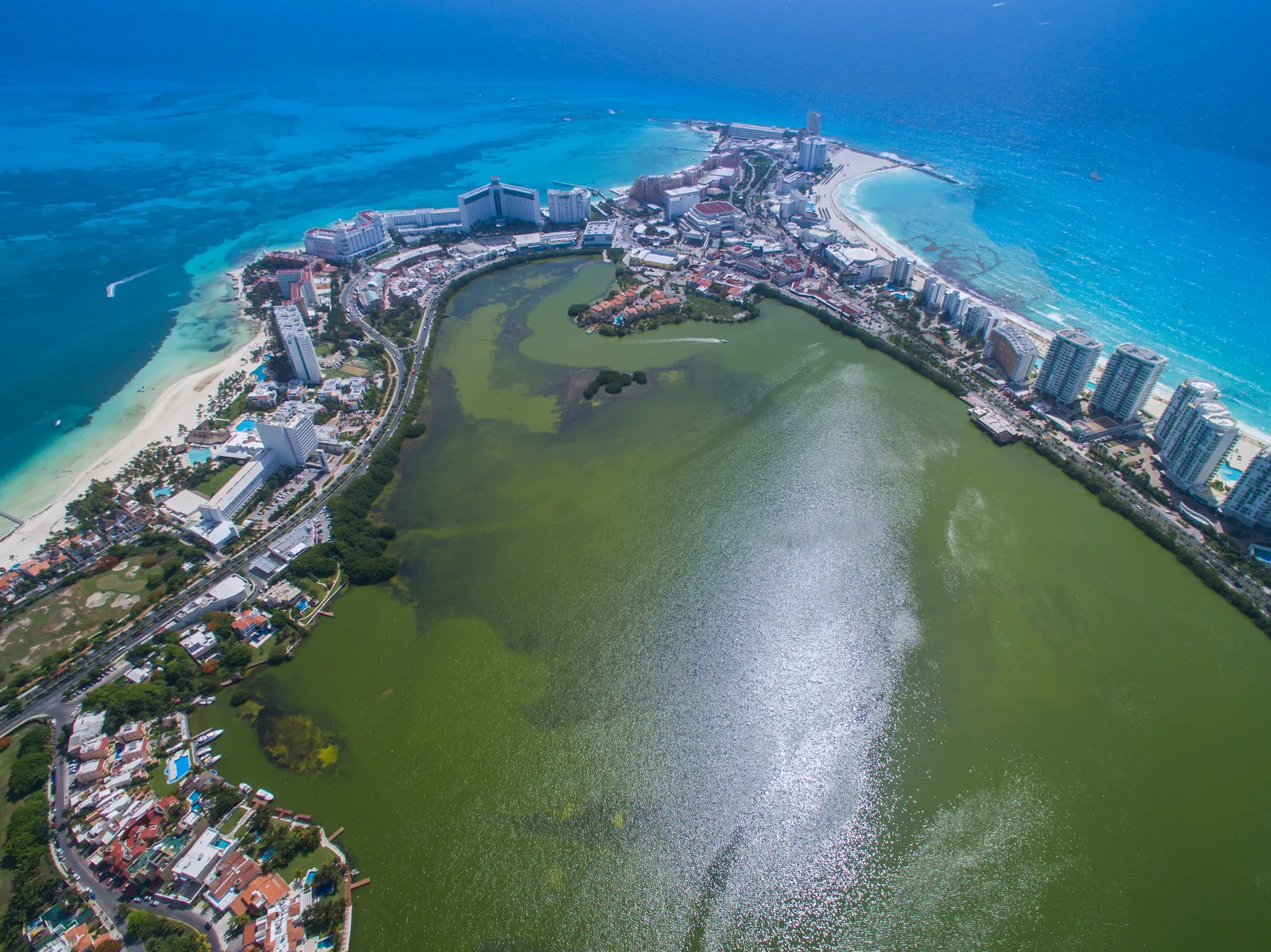
Four days with Cancún as the base: a public beach and the Maya museum, Chichén Itzá and a cenote before the tour buses, Tulum's ruins and a swim, then Isla Mujeres by ferry. One direction out and one ride back each day, dinner downtown where the locals eat.
December to April is dry, 75 to 84°F (24 to 29°C) and busy; Christmas week and the US spring break in March are the peaks. May to October is hot and humid with afternoon storms, and sargassum washes onto the east-facing beaches from roughly April to October, worst in June to August. Hurricane season runs June to November and peaks August to October; late November and early December are the quiet, clear weeks.
Where to base yourself
The Zona Hotelera for the beaches and the lagoon sunsets, with the R1 and R2 buses outside every hotel; the northern end from Punta Cancún back to Playa Langosta has the calm water and least sargassum. Downtown around Parque de las Palapas is half the price, two blocks from the ADO terminal, and on the same buses. Isla Mujeres works as a base if you want quiet nights and do not mind a ferry each morning.
Getting around
The R1 and R2 buses run the whole hotel zone and into downtown 24 hours a day for MX$12 in cash to the driver. ADO coaches leave the downtown terminal on Avenida Tulum for Tulum, Playa del Carmen, Valladolid and Chichén Itzá; buy at ado.com.mx or the window. Colectivo vans run the 307 highway from downtown Cancún to Playa del Carmen (about MX$55) and from Playa to Tulum (about MX$60). Taxis have no meters: agree the fare first.
The one hotel zone beach with no hotel on it: free, public, lifeguards, with the El Mirador viewpoint. Take the R1 or R2 to the Playa Delfines stop around kilometer 18; the surf is strong, so swim between the flags.
A ten-minute walk back up the boulevard. Tuesday to Sunday 9 a.m. to 6 p.m., closed Monday; last entry to the halls 5 p.m. and to the ruins 4:30 p.m., one ticket for both.
The R1 or R2 bus downtown (MX$12), then a ten-minute walk to the market. The fondas in the central patio do fish tacos, pescado frito and a set comida corrida; the stalls around them sell hammocks and silver, so haggle or skip.
Walk the downtown grid: the cantinas and taquerías on Yaxchilán, the small church of Cristo Rey, and the park as it fills up at dusk. Buy a marquesita (a crisp rolled crêpe with cheese and cajeta) from a cart.
The food stalls around the park serve sopes, elotes and tacos for a few pesos each. For a sit-down Yucatecan dinner, La Habichuela a block away has done cochinita pibil and shrimp in coconut since 1977; book on weekends.
Day 2
Chichén Itzá before the tour buses, a cenote, Valladolid
A hired driver is the way to arrive at opening: around MX$4,000 to MX$6,000 for the car. The direct ADO leaves downtown at 8:45 a.m. (about MX$500 one way) with the return at 4:30 p.m.; Yucatán state is one hour behind Cancún.
Gates open at 8 a.m. Yucatán time (9 a.m. on a Cancún phone) and ticket windows close at 4 p.m. One ticket at the gate is MX$697 for foreign adults; see El Castillo and the Sacred Cenote before the tour buses arrive at 10:30 a.m.
Ik Kil is five minutes from the site: a 26-meter open sinkhole, MX$240 with a mandatory life jacket, open 9 a.m. to 5 p.m. Suytun, on the Valladolid side, is a covered cavern for MX$250; shower off sunscreen first.
Forty minutes on from the cenote, in the old house on the main square: lomitos de Valladolid, poc chuc, sopa de lima. The Bazar Municipal on the same square does cochinita and panuchos for a quarter of the price.
The cathedral, the painted houses, and a slow walk down the Calzada de los Frailes to the Convento de San Bernardino de Siena. Cenote Zací is in the middle of town if the morning cenote was skipped.
Back in Cancún after a two and a half hour drive or the ADO from Valladolid. Battered fish and shrimp tacos, a cold beer, no fuss; a ten-minute walk from the ADO terminal.
Take an early ADO from Cancún Centro, two to two and a half hours and MX$270 to MX$400; ask for the Tulum Ruinas stop rather than the pueblo terminal. The Tren Maya from the airport station is around MX$467, but the first train arrives after 9 a.m.
Opens at 8 a.m., last entry 3:30 p.m.; foreigners pay MX$265 at the Jaguar Park entrance (MX$100 park, MX$165 ruins). The walls are a 20-minute walk or a MX$20 shuttle; El Castillo is the point.
Both are on the Cobá road, a few minutes by taxi from the ruins. Gran Cenote is clear and turtle-filled, around MX$500; Calavera is a jump-in hole for MX$300 with a life jacket, open 9 a.m. to 5 p.m.
Cochinita pibil and lechón tacos and tortas from a stand on Avenida Satélite, the town's morning institution. It sells out early in the afternoon; if it has, Antojitos La Chiapaneca on the main avenue opens later for al pastor.
The public stretch of beach just south of the ruins, by taxi or a 20-minute walk from the Jaguar Park entrance. Check the daily sargassum report first; the west-facing beaches of Isla Mujeres are the fallback.
From the pueblo terminal on Avenida Tulum, departures roughly every half hour into the evening; book the return online in the morning. Colectivos to Playa del Carmen and Cancún are cheaper but slower and stop running around 11 p.m.
A patio under the trees in a residential part of downtown, a short taxi from the terminal. Tacos, a decent mezcal list, live music most nights; the place locals take visitors.
Day 4
Isla Mujeres by ferry, a golf cart to Punta Sur, a last sunset
Take an R1 signed Puerto Juárez (MX$12) or a taxi. Ultramar boats leave Gran Puerto roughly every half hour in the morning, about 20 minutes and around MX$270 each way.
Rental offices sit within two blocks of the ferry: MX$300 to MX$500 an hour or around MX$1,300 for the day, 9 a.m. to 5 p.m., with license and deposit. The island is eight kilometers long.
A five-minute walk from the pier: waist-deep calm water, white sand and usually no sargassum. The free public sand is at the western end; the beach clubs charge a minimum spend for a bed.
Down the east coast road past the Tortugranja turtle sanctuary to the southern tip: the small temple of Ixchel, a sculpture garden and cliff paths over the reef. MX$100 entry, cash only.
A seafood shack on the sand by the lagoon on Avenida Rueda Medina, a short walk from the pier. Ceviche, grilled octopus, whole fried fish; cash, and order the catch of the day rather than the menu.
Return the cart by 5 p.m., then back to the beach for the only proper sea sunset on this coast. Boats to Puerto Juárez run about every half hour until early evening; check the last sailing at the pier.
Back across the water and an R1 bus to kilometer 12.6 on the lagoon side of the hotel zone. Shrimp tacos, fish a la plancha and a mango michelada at plastic tables over the water; informal and not expensive for the zone.
Loading the map…
Pins are approximate. Tap one for the stop; the directions links open Google Maps.
The practical bits
From the airport
From Cancún airport (CUN), the ADO bus to the downtown terminal runs every 30 to 45 minutes for about MX$98 to MX$140 and takes 25 minutes; a separate ADO service to the hotel zone runs five times a day in the afternoon for about MX$140. An authorized taxi or a pre-booked private transfer to the hotel zone is MX$750 to MX$1,000 a car and shared shuttles start around MX$300 a person. Buy the bus ticket at the counter after customs, not online, because it is tied to one departure. Ignore the timeshare desks between customs and the exit.
What a day costs
About MX$1,500 to MX$2,500 a day per person for meals, tickets and transport on the Cancún, Tulum and Isla Mujeres days; a market lunch is MX$150, a sit-down dinner MX$400 to MX$600, a cenote MX$250 to MX$500. The Chichén Itzá day costs more: the ticket alone is MX$697, and a shared driver adds around MX$1,200 a head.
Where to stay
Zona Hotelera
Twenty kilometers of beach hotels on a sandbar between sea and lagoon. The northern bend from Punta Cancún to Playa Langosta has calm water and sunsets; the long east side has surf and sargassum.
Centro
Parque de las Palapas, Avenida Yaxchilán and the markets. Where Cancún eats and where the buses leave from; cheap, lively, and ten minutes from the sand by R1.
Isla Mujeres
A quiet island with a west-facing beach, a 20-minute ferry away. Worth a night if you want slow evenings; the morning boats reach the mainland.
Got a day to spare?
Cozumel
Colectivo or ADO to Playa del Carmen, then the 45-minute ferry; snorkel the Palancar and Colombia reefs from a boat. A long day; leave by 7 a.m.
Cobá
The jungle pyramids 45 minutes inland from Tulum, cycled between on rented bikes; climbing is no longer allowed. The cenotes at Tamcach-Ha and Choo-Ha round it off.
Holbox
Two hours by ADO to Chiquilá and a 20-minute ferry to a car-free sandbar with flamingos and bioluminescence in summer. Better as an overnight than a day.
Worth knowing
Chichén Itzá and Valladolid are in Yucatán state, one hour behind Cancún; phones switch automatically and you lose that hour again coming home.
Cenotes ban sunscreen, including the reef-safe kind: shower before you swim and reapply after. On the beaches and in the Jaguar Park use mineral, biodegradable sunscreen; the chemical kind is not allowed.
Carry pesos in small notes. Buses, colectivos, cenotes, Punta Sur and the taco stands are cash, and ATMs in the hotel zone charge heavily; the bank ATMs downtown are cheaper.
Book ADO coaches at ado.com.mx or in the app the day before; the early Tulum and Valladolid departures and the 4:30 p.m. return from Chichén Itzá fill up. A foreign card sometimes fails online, so have the window as a fallback.
Tip 10 to 15 percent in restaurants (check the bill for a servicio line first), MX$20 to MX$50 for porters and drivers who help with bags, and in pesos rather than dollars.
Things you can ask once it’s in the app
Plans change. Ask Chat and it proposes a reshuffled day you can apply, or just answers the question.
Swap Chichén Itzá for Cobá and Tulum in one day, is that realistic?The sargassum forecast is bad for day 3, where should we swim instead?How do we get from the airport to the hotel zone without a taxi?Find a vegetarian dinner near Parque de las PalapasWhat time do we need to leave Cancún to be at Tulum when it opens?
Questions
Do I need a car?
No. ADO coaches, colectivos and the R1 bus cover every stop here. A hired driver for the Chichén Itzá day is the one place a car earns its cost, and it still beats renting for the week.
Is Chichén Itzá worth MX$697?
Yes if you arrive at opening and leave by 11:30 a.m. After noon it is hot and full of tour groups.
Which day works in the rain?
Day 1: the Museo Maya is indoors and Mercado 28 is covered. Cenotes are fine in rain and the ruins empty out, so days 2 and 3 survive a shower; only the beaches lose. A rain plan in Waystop keeps this day and adds a wet-weather version beside it.
What about the Tren Maya?
It runs from the airport station south to Tulum and west to Chichén Itzá and Valladolid, but the stations sit outside the towns and the departures are few. Good for a one-way leg if you are moving on to Mérida; for day trips the bus or a driver is simpler.
Add your dates, your hotel and who’s coming, then ask Chat to change anything: it proposes the edit and you tap Apply. Want a long lunch instead of a museum? Just ask. Every place is checked against Google Maps before it lands on your day, and Chat can tell you when to leave for the next stop. Going on to another city? Build a multi-city trip.